Affiliate Disclosure: This post may contain affiliate links. If you purchase through them, DobermanSmarts may earn a small commission at no additional cost to you. We only recommend products, tools, and resources we genuinely believe can help Doberman owners.
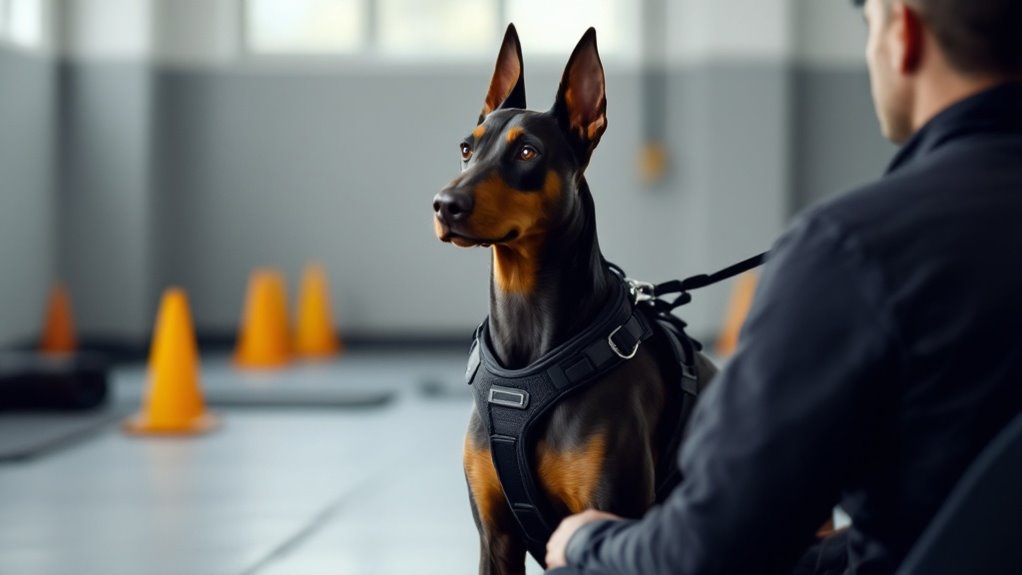
Yes, you can train a Doberman as a service dog if you have a diagnosed disability, medical documentation supporting a service dog as appropriate treatment, and commitment to consistent daily training. Dobermans excel at mobility assistance, psychiatric support, and medical alert tasks due to their intelligence, trainability, and strong handler focus. Success requires months to years of dedicated work, an experienced trainer, and careful management of the breed’s separation-anxiety tendencies. Understanding the legal distinctions, training pathways, and realistic daily demands will shape whether this path truly fits your needs.
- Key Takeaways
- Yes: Dobermans Have the Traits Service Dogs Need
- Service Dogs vs. ESAs: Why Dobermans Fit the Service Role
- Do You Qualify? Medical and Disability Requirements Explained
- Owner-Trained vs. Program-Trained: Cost, Timeline, and Finding a Trainer
- Tasks Dobermans Excel At: Mobility, Psychiatric, and Medical Alert Work
- Why Your Doberman’s Appearance Affects Public Access
- Legal Protections for Doberman Service Dogs: Breed Discrimination and BSL Exemptions
- Train a Well-Mannered Doberman: Socialization and Handling Essentials
- Never Do This: Why Protection Training Creates Legal Liability
- Prevent Separation Anxiety Before Public Access Begins
- Daily Life With a Service Doberman: Time, Cost, and Routine Reality
- Your Action Checklist: From Decision to First Training Session
- Frequently Asked Questions
- Conclusion
Key Takeaways
- Dobermans possess ideal service dog traits: high intelligence, strong handler focus, calm temperament, and large frames suitable for mobility tasks.
- Service dog qualification requires a diagnosed disability, clinician confirmation that a service dog addresses functional limitations, and specific task training.
- Training paths include owner-trained (months to years, $50–$200+ per session) or program-trained ($5,000–$25,000, two-year waiting lists typical).
- Dobermans excel at mobility assistance, deep pressure therapy, and medical alerting tasks when properly socialized and trained consistently.
- Daily exercise (60–90 minutes) and mental enrichment (20–40 minute training sessions) are essential to prevent anxiety and maintain service reliability.
Yes: Dobermans Have the Traits Service Dogs Need
Because Dobermans were originally developed as working dogs, they possess the foundational traits that service dog programs depend on: intelligence, trainability, and a natural drive to focus on their handler. The Doberman Pinscher excels at learning complex, task-specific work such as mobility assistance, item retrieval, and medical alerting.
Their task-driven nature creates strong handler focus—often called “velcro” bonding—which supports the sustained attention and reliability required for psychiatric grounding or crowd blocking. Additionally, their calm, alert temperaments combined with large, deep-chested bodies make them well-suited for deep pressure therapy and physical support tasks like bracing or balance assistance.
These structural and behavioral characteristics form a solid foundation for service work, though individual temperament and careful breeding selection ultimately determine success.
Service Dogs vs. ESAs: Why Dobermans Fit the Service Role
While emotional support animals (ESAs) provide comfort through companionship alone, service dogs like well-trained Dobermans perform specific, disability-related tasks that meet legal and functional standards under the Americans with Disabilities Act.
Your Doberman service dog undergoes structured training to execute concrete tasks—mobility assistance, medical alerting, deep pressure therapy, or grounding techniques—that directly address your disability.
This task-specific training distinguishes your service dog from an ESA, granting you full public access rights in housing, transportation, and businesses.
ESAs lack these protections because they provide emotional support without performing trained tasks.
Your Doberman’s intelligence, alertness, and strong bonding tendencies make the breed particularly effective for psychiatric service work, including crowd blocking and person-finding.
This reliability and consistency define the service dog role.
Do You Qualify? Medical and Disability Requirements Explained
To qualify for a service dog, you’ll need a diagnosed disability—a physical or mental condition that substantially limits one or more major life activities—and a licensed medical professional (doctor, psychologist, or psychiatrist) should confirm that a service dog is an appropriate treatment option for your specific situation.
Your disability must create functional limitations that a trained dog can directly address through measurable tasks, whether that’s mobility assistance, seizure alerting, deep pressure therapy for PTSD, or another concrete intervention.
Consulting with your healthcare provider before pursuing Doberman service dog training guarantees you’re investing time and resources in an intervention that’ll actually support your documented needs.
Disability Must Limit Function
Before you can qualify for a service dog under the Americans with Disabilities Act, you’ll need to meet specific legal requirements that center on how your disability affects your daily life.
Your disability must substantially limit one or more major life activities, meaning it genuinely impairs your functioning in meaningful ways. The ADA recognizes disabilities that restrict:
- Physical capabilities like walking, standing, or maintaining balance
- Sensory functions including vision, hearing, or speech
- Cognitive or mental processes such as concentration, memory, or emotional regulation
You must demonstrate that your condition markedly interferes with daily tasks, not simply that you experience occasional difficulty.
A clinician typically evaluates whether your disability causes substantial functional limitations and whether a service dog performing specific tasks could address those limitations meaningfully.
Medical Professional Consultation Required
Getting a service dog requires documentation from a licensed medical professional that confirms you have a disability substantially limiting one or more major life activities and that a dog trained to perform specific tasks would meaningfully reduce those functional limitations.
Your clinician doesn’t need to complete a specific form; a written recommendation stating that a service dog represents an appropriate assistive intervention typically suffices for program placement or training pursuit. However, your clinician will need sufficient clinical detail about your functional impairments to justify how a Doberman’s tasks directly address your documented limitations.
Whether you experience seizures, panic attacks preventing daily errands, or PTSD requiring grounding techniques, your clinician evaluates the severity, frequency, and real-world impact before endorsing service dogs as medically appropriate for your situation.
Service Dog As Treatment Option
Qualifying for a service dog requires that you’ve got a documented disability—a physical or mental condition that substantially limits one or more major life activities—and that a medical professional agrees a task-trained dog will meaningfully reduce your functional limitations.
Service dogs differ fundamentally from emotional support animals because they perform concrete, measurable work. Your clinician will evaluate whether a Doberman trained for specific tasks addresses your needs:
- Deep pressure therapy for panic attacks or anxiety episodes
- Mobility assistance or balance support for physical limitations
- Seizure alerting or diabetic response tasks
The severity of your functional limitations and available treatment options determine appropriateness. Your medical professional assesses whether task-trained service dogs constitute the right intervention for your circumstances, considering the dog’s reliability, your ability to maintain control, and public safety requirements.
Owner-Trained vs. Program-Trained: Cost, Timeline, and Finding a Trainer
When you’re ready to pursue service-dog training for your Doberman, you’ll face a fundamental choice between two distinct paths: training your dog yourself or enrolling in a professional program, each presenting different costs, timelines, and demands on your resources.
Owner-trained dogs require months or years of daily, consistent work alongside professional support—private lessons and behaviorist consultations typically range from $50–$200+ per session. Program-trained Dobermans from reputable organizations cost $5,000–$25,000 but arrive ready for public access, though waiting lists average two years.
Your decision depends on your medical urgency, available time, budget, and local trainer access. Owner-training offers lower upfront costs but slower, riskier results. Program training demands significant expense yet provides faster, more reliable outcomes.
Tasks Dobermans Excel At: Mobility, Psychiatric, and Medical Alert Work
Once you’ve selected a training path and committed to the timeline and investment required, you’ll want to understand what tasks your Doberman can actually perform well, since breed strengths directly shape realistic training goals and outcomes.
A Doberman as a service dog excels across three primary categories:
- Mobility tasks—bracing for balance, retrieving dropped items, opening and closing doors, and turning lights on and off, leveraging their intelligence and task-driven focus.
- Psychiatric support—providing deep pressure therapy and grounding during crises through their calm temperament and large size, reducing panic and acute anxiety.
- Medical alerting—detecting seizures or blood-sugar changes through their alertness and close bonding with handlers.
Success requires early socialization, ongoing mental and physical stimulation, and temperament screening to guarantee public-appropriate behavior.
Why Your Doberman’s Appearance Affects Public Access
Your Doberman’s physical appearance—particularly cropped ears and the breed’s naturally alert, muscular build—frequently triggers skepticism from business staff and the general public, despite your legal right to public access with a service dog. Staff may question your dog’s legitimacy or request removal based on perceived threat rather than actual behavior, even though businesses can only ask two legal questions about service animals.
You can reduce confrontations markedly by leaving your Doberman’s ears uncropped and maintaining a clean, well-groomed appearance. Adding visible service identifiers like a vest or ID tag signals the dog’s working role and increases cooperation from professionals and the public.
When questioned, calmly demonstrate your dog’s task-focused behavior to reinforce that your Doberman operates reliably in public spaces.
Legal Protections for Doberman Service Dogs: Breed Discrimination and BSL Exemptions
Although breed-specific laws and housing restrictions targeting Dobermans pose real obstacles, federal disability law provides substantial protections for service dogs regardless of breed. The ADA preempts many public-access restrictions, while the Fair Housing Act requires landlords to accommodate qualified service animals even with breed bans, unless your dog poses a direct threat or causes substantial property damage.
You can strengthen your position through these strategies:
- Carry medical documentation linking your disability to your dog’s specific trained tasks
- Prepare clear explanations of your Doberman’s role when facing breed-specific discrimination
- Document your dog’s reliability, consistency, and controlled behavior in public settings
Municipalities may still exclude an out-of-control dog, so maintaining your service dog’s training and handler responsibility remains essential for protecting your access rights.
Train a Well-Mannered Doberman: Socialization and Handling Essentials
You’ll need to start socializing your Doberman within the first 3–14 weeks of life, exposing him regularly to varied people, children, other dogs, different surfaces, unfamiliar sounds, and public spaces so he develops confidence rather than fear-based reactivity.
Managing separation anxiety requires you to involve all household members in feeding, handling, play, and training from puppyhood, which counters the breed’s natural tendency toward one-person attachment and reduces the risk of protective or resource-guarding behaviors that complicate service work.
Pairing consistent early socialization with at least 60–90 minutes of daily physical exercise plus structured mental work—such as task training, scent games, and obedience drills—channels his high energy and task-drive into the calm, reliable focus that public access demands.
Early Socialization With Humans
Because a service Doberman must remain calm and nonreactive in unpredictable public settings, early socialization with humans establishes the behavioral foundation for all future training.
You’ll build this foundation through controlled, consistent exposure during the critical 3–14 week window, when your puppy’s brain remains most receptive to new experiences.
Structure your socialization around these key practices:
- Arrange 50–100 positive person-dog interactions weekly through petting, treat-giving, and brief handling drills that normalize touch on paws, ears, and mouth
- Rotate multiple family members through feeding, grooming, and training sessions to prevent over-attachment and handler-dependent guarding behaviors
- Introduce varied body types, ages, and behavioral styles so your Doberman recognizes humans as reliably predictable and nonthreatening
This consistent, systematic approach creates the calm baseline service dogs require for public reliability.
Managing Separation Anxiety Issues
While early socialization creates a calm baseline, service Dobermans also need systematic preparation for time alone, since separation anxiety can undermine their reliability in public settings and damage your home.
You’ll prevent single-handler over-attachment by distributing caregiving duties—feeding, play, grooming, and training—among family members from puppyhood, ensuring your dog bonds securely with multiple people rather than depending on one handler.
Build independence gradually through short departures starting at 30–60 seconds, using randomized schedules and rewarding calm behavior upon return. Increase duration incrementally by only 10–20% per session to avoid triggering setbacks.
If excessive vocalization, destructive behavior, or house soiling persists despite consistent training, consult a certified behaviorist who can develop a counterconditioning plan, possibly including veterinary-recommended medication.
Exercise And Mental Stimulation
Service Dobermans demand substantial daily exercise and mental stimulation to maintain the focus and calm temperament that reliable service work requires, since their high energy and intelligence can easily redirect toward destructive or reactive behaviors if left unmanaged.
You’ll need to structure both physical and cognitive activities into your dog’s routine to channel these natural drives productively.
- Long walks, jogging, or agility work for 60–90 minutes daily burns excess energy and builds endurance for extended public access tasks
- Focused training sessions spanning 20–40 minutes daily—incorporating task repetition, trick chaining, and scent games—leverage Dobermans’ intelligence and redirect attention toward handler-specific duties
- Puzzle feeders and interactive toys during downtime maintain mental engagement and prevent boredom-driven problem behaviors
Consistency across both exercise types strengthens your dog’s reliability and prevents the reactive patterns that undermine service-dog performance.
Never Do This: Why Protection Training Creates Legal Liability
Adding protection training to a service dog fundamentally changes your legal position as a handler, because you become responsible for any injuries the dog inflicts, and courts view protection-trained dogs as inherently more dangerous than assistance animals.
Insurers often deny coverage or void existing policies when protection training enters the picture, leaving you financially exposed.
Additionally, protection training blurs the distinction between legitimate assistance work and guard work, which weakens your ADA protections and makes public access denials more likely.
If your dog responds aggressively in public, law enforcement and businesses will treat it as a dangerous animal rather than a service dog, potentially resulting in removal, quarantine, or euthanasia depending on local regulations.
Reputable trainers prohibit this combination specifically to prevent unpredictable responses and escalation.
Prevent Separation Anxiety Before Public Access Begins
You’ll need to prevent separation anxiety before your Doberman enters public access work, since early independence training and gradual departures—starting with multiple short 5–10 minute absences during puppyhood and extending to 30–60 minutes as your dog matures—build the foundation for calm solo behavior that service work demands.
The Velcro bond characteristic of Dobermans creates real risk if you don’t actively distribute handling, feeding, and training across multiple household members from the start, which prevents the single-person over-attachment that typically triggers separation distress when you’re unavailable.
Predictable daily structure, including 60–90 minutes of vigorous exercise plus mental engagement, reduces the excess arousal that commonly underlies anxiety problems and allows your dog to develop genuine coping skills rather than reactive behaviors.
Building Independent Coping Skills
Before your Doberman can reliably perform tasks in public settings, they’ll need to develop genuine independence and coping skills that prevent separation anxiety from undermining their training. Building these skills requires structured practice and consistency over weeks, not days.
Make sure you establish a predictable routine by:
- Starting with 30–60 second departures, then increasing duration by 10–20% every few days so your dog learns absences are temporary
- Teaching a reliable “place” command on a mat or crate, rewarding calm settling for 15–30 minutes initially, progressing to hours
- Providing high-value enrichment like frozen Kongs or food-dispensing toys during absences to redirect arousal and occupy focus
This gradual progression builds confidence through experience rather than forcing independence prematurely.
Gradual Desensitization To Separation
Because separation anxiety can emerge suddenly and derail months of service dog training, you’ll need to establish your Doberman’s tolerance for alone time long before public access work begins, starting in puppyhood with intentional, measured progressions that build genuine confidence rather than mask underlying stress.
Begin with 30–60 second separations, increasing duration by only 10–20% daily to prevent panic responses.
Simultaneously, teach reliable settling behaviors on a mat using high-value rewards, extending sessions from 5–10 minutes to 30–60 minutes before allowing unsupervised freedom.
Practice non-emotional departures and returns—no prolonged goodbyes or excited greetings—so your dog doesn’t associate your exits with anxiety.
If destructive behavior, vocalizing, or toileting occurs, pause progression immediately and consult an experienced Doberman behaviorist.
Managing The Velcro Bond
The settling behaviors you’ve built through gradual desensitization form the foundation, but they won’t prevent separation anxiety on their own if your Doberman’s attachment to you remains absolute. Velcro dogs need structural changes to their environment and routines to distribute attachment across multiple people.
Begin by rotating primary caregiver duties among household members for at least three to six months:
- Alternate who feeds, walks, and handles the puppy during daily routines
- Assign different people to conduct training sessions and provide rewards
- Rotate nighttime sleeping arrangements so the dog doesn’t sleep exclusively with one person
Consistency across all handlers matters more than perfection with one person. Your Doberman learns reliability through varied relationships, not exclusive dependency, reducing the intensity of the velcro bond before public access work begins.
Daily Life With a Service Doberman: Time, Cost, and Routine Reality
Owning a service Doberman requires a substantial daily commitment that goes well beyond standard pet ownership, demanding consistent time investment, careful financial planning, and lifestyle adjustments that affect nearly every aspect of your routine.
You’ll spend 60–120 minutes daily on focused training and mental enrichment, plus 30–60 minutes on vigorous exercise, which prevents problem behaviors and maintains task reliability.
Monthly care costs run $80–$200 for food, routine veterinary care, grooming, and preventive medications, with significant spikes during health issues.
Professional training programs cost $5,000–$25,000 upfront, while owner-training paths require years of personal effort and potential private-trainer fees of $50–$200 hourly.
Multiple weekly socialization outings to varied environments guarantee your service dog performs reliably in public settings, clinics, and stores while remaining calm amid crowds and distractions.
Your Action Checklist: From Decision to First Training Session
Before you commit to training a Doberman as a service dog, you’ll need to move through several critical decisions and preparations that’ll shape your success from the start.
Training a Doberman as a service dog requires critical decisions and thorough preparations that fundamentally shape your success.
Start by securing medical documentation confirming your disability meets the legal threshold for service dogs, then select a Doberman with appropriate temperament through a reputable breeder or trainer assessment.
- Evaluate owner-trained versus program-trained paths, weighing cost savings against time demands and trainer access.
- Schedule an initial consultation with a Doberman-experienced trainer to assess your dog’s readiness for task-specific training.
- Research local breed-specific legislation, landlord policies, and housing requirements affecting your Doberman’s legal status.
These steps establish the foundation for reliable service dog training, ensuring consistency and clarity throughout the training process.
Frequently Asked Questions
Why Don’t Police Use Dobermans Anymore?
You’ll find police departments shifted away from Dobermans because they’re too handler-focused and unpredictable. German Shepherds and Belgian Malinois offer better versatility, steadier temperaments, and broader public acceptance for modern community policing needs.
Does Lupus Qualify for a Service Dog?
Yes, lupus can qualify you for a service dog if it substantially limits major life activities and you need a trained dog to perform specific disability-related tasks like medication reminders or mobility assistance during flares.
How Much Does It Cost to Train a Doberman to Be a Guard Dog?
You’re looking at $2,000 to $10,000-plus for specialized protection training, but here’s what catches most owners off guard: liability insurance, legal risks, and handler certification can easily double your total investment.
Can I Get a Service Dog for Crohn’s Disease?
Yes, you can qualify for a service dog for Crohn’s disease if your condition substantially limits major life activities and a medical professional documents that a trained dog would perform specific symptom-mitigation tasks.
Conclusion
You can train a Doberman as a service dog, though success depends on your commitment to structure and consistency. They’ve got the intelligence and athleticism for mobility, psychiatric, and medical alert tasks, but you’ll need reliable training—whether through programs or qualified trainers. The real challenge isn’t their capability; it’s maintaining the discipline required for public access work and avoiding protection training that creates legal liability.