Affiliate Disclosure: This post may contain affiliate links. If you purchase through them, DobermanSmarts may earn a small commission at no additional cost to you. We only recommend products, tools, and resources we genuinely believe can help Doberman owners.
Your Doberman’s problem-solving abilities stem from their cognitive structure, which facilitates rapid threat assessment, pattern recognition, and independent decision-making. They typically learn commands within a few repetitions due to exceptional focus and can navigate unfamiliar situations through active analysis. Their brain strength develops through early socialization, varied environmental exposure, and consistent training that breaks complex tasks into manageable steps. Mental engagement through scent work, agility, and puzzle toys reinforces these capabilities, while emotional stability and structured routines optimize their reliability in dynamic scenarios. Understanding how to calibrate challenge levels and maintain consistency reveals their full potential.
- Key Takeaways
- Why Your Doberman’s Brain Works Like a Problem-Solving Machine
- How Dobermans Learn Faster Than Most Dog Breeds?
- Break Down Complex Tasks Into Manageable Steps
- Quick Decision-Making in Real-World Situations
- Why Dobermans Excel at Working Roles?
- Born to Solve: What Genetics Means for Your Doberman’s Smarts
- How Early Socialization Wires Your Doberman’s Brain
- Training Methods That Unlock Problem-Solving Skills
- Teach Heel-to-Auto-Sit, Send-Away, and Emergency Recall
- Nose Work and Scent Games for Focused Mental Challenges
- Agility Training: Problem-Solving With Your Body
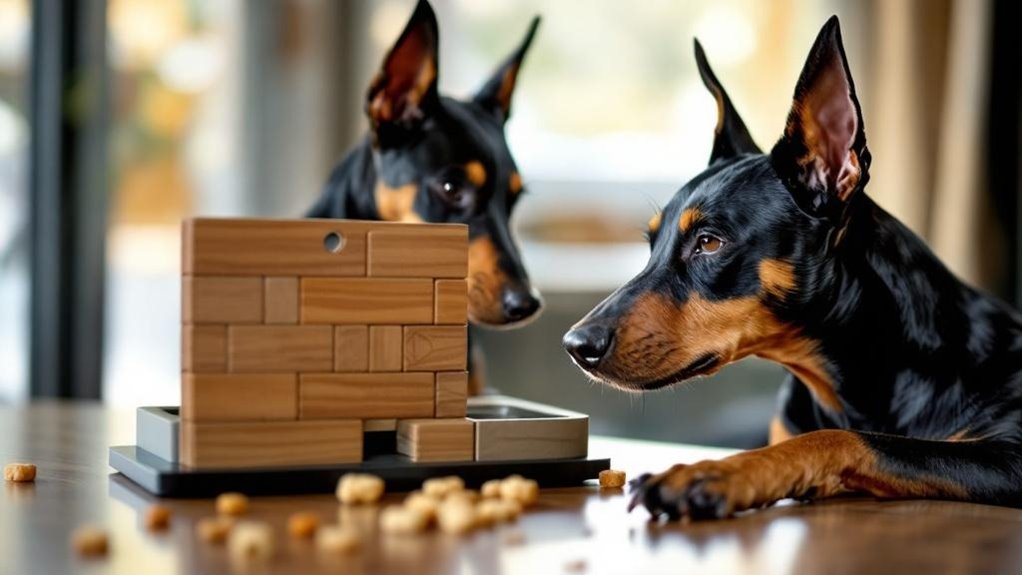
- Puzzle Toys: Make Your Doberman Think
- DIY Brain Games: Treat Towels, Cardboard Boxes, and Hidden Objects
- Why Your Doberman’s Emotional Sensitivity Shapes How They Learn
- Build Confidence Through Progressive Challenges
- Spot Frustration Before It Breaks Your Training Session
- Recognize Boredom (and Fix It Before Destruction Starts)
- Rotate Activities to Keep Mental Work Fresh
- Common Mistakes Owners Make When Training Problem-Solving
- Use Consistency and Structure to Wire Better Problem-Solving
- Track Progress: Signs Your Doberman Is Getting Smarter
- Adjust Difficulty Levels: When to Push and When to Hold Back
- Pair Mental Work With Emotional Connection for Long-Term Growth
- Frequently Asked Questions
- Conclusion
Key Takeaways
- Dobermans grasp complex commands in few repetitions due to exceptional cognitive abilities and active pattern recognition skills.
- Their innate threat assessment capacity, combined with training, enables reliable real-time decision-making in unpredictable environments.
- Early socialization between three to sixteen weeks establishes neural pathways crucial for adaptability and problem-solving confidence.
- Advanced training methods like scent work and puzzle toys stimulate independent thinking and mental engagement effectively.
- Varied activities and consistent structure prevent boredom while strengthening neural pathways for sustained learning and capability.
Why Your Doberman’s Brain Works Like a Problem-Solving Machine
Why does your Doberman seem to grasp new commands so quickly, or navigate unfamiliar situations with such confidence? Your dog possesses an exceptional brain structure designed for problem-solving.
Your Doberman’s exceptional brain structure enables rapid command mastery and confident navigation through unfamiliar situations with remarkable problem-solving prowess.
Dobermans demonstrate remarkable cognitive abilities that enable them to assess dynamic scenarios and respond with quick decision-making skills. Their intelligence allows them to learn new tasks with impressive speed, often mastering cues in just a few repetitions.
This problem-solving capacity stems from their breeding as versatile working dogs, where rapid assessment and adaptation proved essential. Your Doberman’s brain doesn’t simply follow instructions; it actively analyzes situations, identifies patterns, and determines appropriate responses.
This natural cognitive architecture means your dog can tackle complex challenges independently, making them reliable partners in roles requiring quick thinking and adaptability.
How Dobermans Learn Faster Than Most Dog Breeds?
You’ll find that your Doberman acquires new commands within just a few repetitions, a capability that stems from their neurological structure and exceptional focus, which allows them to process information more efficiently than most dog breeds.
Their quick decision-making skills enable them to assess situations rapidly and respond with appropriate actions, making training sessions remarkably productive when you maintain consistency and clarity in your commands.
This combination of rapid learning and swift problem-solving means you can introduce more complex tasks sooner, building on their foundation of reliable obedience and deepening their understanding of what you’re asking them to accomplish.
Rapid Command Acquisition
Because Dobermans possess exceptional cognitive abilities and sharp decision-making skills, they’ve earned a reputation for acquiring new commands faster than most dog breeds, often mastering tasks in just a few repetitions.
Their rapid command acquisition stems from their natural intelligence and capacity for quick mental processing, which allows them to understand patterns and expectations with minimal instruction.
To maximize their learning potential, you’ll benefit from using positive reinforcement techniques combined with short, focused training sessions lasting five to ten minutes.
This structure prevents mental fatigue while maintaining their engagement. Consistency and reliability in your training approach directly influence how quickly they internalize commands.
Quick Decision-Making Skills
Dobermans don’t just learn commands quickly—they make rapid decisions in real-time situations, which sets them apart from most other breeds. Their strong problem-solving abilities enable you to rely on them in unpredictable environments where quick thinking matters.
When you train your Doberman with varied tasks and challenges, you’re strengthening their decision-making capacity:
- Exposure to different scenarios builds their ability to assess situations and respond effectively without hesitation.
- Mental stimulation through structured training prevents boredom while reinforcing their natural adaptability.
- Positive reinforcement creates consistency and reliability in their responses to complex commands.
Your Doberman’s genetic predisposition toward rapid learning means they’ll quickly learn new skills and apply them across contexts. This combination of intelligence and decisiveness makes them invaluable for police and military work, where lives depend on immediate, accurate responses.
Break Down Complex Tasks Into Manageable Steps
When you’re teaching your dog a complex behavior, breaking the task into smaller steps makes the learning process far more manageable for both of you.
Your Doberman’s exceptional intelligence and ability to learn new commands quickly allow you to introduce one element at a time, building gradually toward the complete behavior without frustration. This approach, called task chaining, links multiple simple behaviors together, helping your dog track progress while mastering advanced sequences.
Quick Decision-Making in Real-World Situations
When you observe a Doberman in action, you’ll notice they’re constantly reading their environment, evaluating potential threats, and determining the appropriate response based on what they perceive as real danger versus routine activity.
Their training builds on this natural instinct, allowing them to maintain consistency and reliability even when faced with unexpected situations that demand immediate judgment calls.
You can count on this breed’s capacity to adapt their reactions to different scenarios, shifting from calm alertness to decisive action as circumstances require.
Assessing Threats and Situations
Because split-second decisions can determine outcomes in dangerous situations, the ability to assess threats quickly stands as one of the Doberman Pinscher’s most valuable traits.
You’ll find that their innate capacity to evaluate circumstances develops through both instinct and training, creating a reliable foundation for protection work.
Their threat assessment relies on three primary components:
- Sensory Analysis: You can observe how Dobermans process visual, auditory, and olfactory information simultaneously, allowing them to detect subtle environmental changes before they escalate.
- Real-Time Evaluation: Their police and military training emphasizes distinguishing routine activities from genuine threats, enabling you to trust their responses.
- Situational Awareness: Early socialization guarantees they make appropriate decisions when encountering unfamiliar stimuli, balancing protection with safety.
This combination of intelligence, sensory skills, and protective instinct enables you to rely on their ability to respond decisively and accurately.
Adaptive Responses Under Pressure
Several factors combine to enable Dobermans’ quick decision-making abilities when they’re faced with pressure and unexpected challenges. Their sharp mind processes information rapidly, allowing them to evaluate situations and select appropriate responses within seconds. This adaptive capacity stems from their breeding history in roles requiring immediate judgment, such as police and military work.
You’ll notice that Dobermans’ adaptive responses under pressure develop through consistent training and real-world exposure. When you present situational challenges during practice sessions, you’re strengthening their cognitive pathways and reinforcing reliable decision-making patterns.
Their natural instincts combine with learned behaviors, creating a structure for quick assessment and action. This reliability makes them effective in unpredictable environments where split-second choices matter greatly.
Why Dobermans Excel at Working Roles?
Dobermans excel in working roles because they’ve inherited a combination of traits that directly address the demands of specialized tasks, from police work to military operations. Their intelligence enables rapid learning and adaptation, while their protective instincts drive consistent performance in high-pressure environments.
You’ll find Dobermans excel through several interconnected strengths:
- Quick Assessment and Response: Their problem-solving abilities allow them to evaluate situations rapidly and formulate effective solutions without hesitation, essential in unpredictable operational contexts.
- Collaborative Capability: They work seamlessly with handlers, executing complex commands reliably in dynamic conditions through strong handler-dog partnership.
- Sustained Motivation: Their inherent drive, combined with proper training, produces outstanding performance across versatile positions requiring consistency and reliability.
These traits work together, creating dogs who understand nuance, respond decisively, and maintain focus under demanding circumstances.
Born to Solve: What Genetics Means for Your Doberman’s Smarts
Genetics, not training alone, determines much of your Doberman’s exceptional problem-solving capacity. Your Doberman Pinscher inherits hardwired traits from generations of breeding for protection work, which shaped their mental structure for quick decision-making and adaptability.
This genetic foundation enables your dog to process complex situations rapidly, assess threats, and respond effectively without extensive conditioning. The breed’s lineage emphasizes traits that support scent detection, agility training, and task execution, giving your Doberman natural advantages in learning new challenges.
While training builds consistency and reliability in their responses, genetics provides the underlying capacity for intelligence. Understanding this distinction helps you work with your dog’s natural abilities rather than against them, creating a realistic framework for developing their problem-solving skills throughout their life.
How Early Socialization Wires Your Doberman’s Brain
You’re shaping your Doberman’s brain during those critical early weeks through structured exposure to diverse people, environments, and situations, which teaches your dog to assess and respond effectively to new challenges.
This environmental exposure doesn’t just build confidence; it actually rewires your dog’s neural pathways to differentiate between safe and potentially threatening situations, improving decision-making skills that’ll serve them throughout their life.
Critical Neural Development Windows
During the first three to sixteen weeks of your puppy’s life, their brain’s neural pathways are forming at an accelerated rate, creating what researchers call a critical neural development window—a period when early experiences have outsized influence on how their brain will function throughout adulthood.
You’re fundamentally wiring your Doberman’s nervous system during these formative weeks, establishing the foundation for how they’ll process information and respond to challenges.
During this time, you should prioritize:
- Introducing varied environments, people, and animals to build neural flexibility
- Allowing safe exploration that develops problem-solving confidence
- Maintaining consistent, positive interactions that establish reliable neural pathways
Puppies who miss this window often develop anxiety and suspicion, struggling to assess situations effectively.
Your Doberman’s ability to think critically and adapt depends directly on the experiences you provide now, establishing the neural structure that supports learning throughout their life.
Environmental Exposure Shapes Decision-Making
Because your puppy’s brain is still forming its neural pathways, the environments you expose them to during these critical weeks directly shape how they’ll assess and respond to situations throughout their life. Environmental exposure during this period trains your Doberman to make calm, confident decisions rather than defaulting to suspicion or anxiety.
| Exposure Type | Benefit | Timeline |
|---|---|---|
| Diverse people | Reduces wariness | Up to 16 weeks |
| Various animals | Improves social assessment | Critical period |
| Different settings | Enhances adaptability | Early months |
When you provide positive experiences in unfamiliar environments, your Doberman develops stronger problem-solving skills. Structured social interactions teach appropriate responses, while regular outings to training workshops and public spaces reinforce critical thinking. This environmental foundation builds reliability in your dog’s decision-making across unpredictable situations.
Building Confident Problem Solvers
When a Doberman puppy encounters diverse people, animals, and environments during their critical development months, their brain forms neural pathways that prioritize assessment over alarm, enabling them to approach unfamiliar situations with curiosity rather than defensiveness.
You’re building confident problem solvers through intentional socialization experiences that rewire their instinctive responses.
This foundational work creates several advantages:
- Reduced fear-based reactions allow your Doberman to think critically instead of reacting impulsively to new challenges.
- Enhanced emotional resilience enables them to process uncertainty and adapt their approach when encountering obstacles.
- Accelerated learning capacity leverages their natural intelligence, allowing them to absorb commands and problem-solving strategies more effectively.
When you structure consistent, positive interactions across varied contexts, you establish the neural architecture necessary for your Doberman to confidently assess situations, think through solutions, and respond with measured consideration rather than reflexive anxiety.
Training Methods That Unlock Problem-Solving Skills
Several structured training approaches can systematically develop a Doberman’s problem-solving capabilities by challenging both their body and mind simultaneously.
Advanced training methods like scent detection and agility courses combine physical activity with mental engagement, strengthening analytical thinking. Positive reinforcement through clicker training rewards your Doberman for completing complex tasks, encouraging critical thinking.
Advanced training methods like scent detection and agility courses strengthen analytical thinking while clicker training encourages critical problem-solving.
Interactive games and puzzles stimulate independent problem-solving by requiring analysis and decision-making. Introducing varied commands maintains mental engagement and reduces boredom, fostering your dog’s natural inclination to think strategically.
Training in different environments with distractions improves adaptability, enabling your Doberman to solve problems in unpredictable situations.
These training methods create a foundation where your dog develops reliability and consistency in approaching challenges with confidence and composure.
Teach Heel-to-Auto-Sit, Send-Away, and Emergency Recall
As your Doberman progresses through foundational obedience training, teaching three advanced commands—Heel-to-Auto-Sit, Send-Away, and Emergency Recall—builds the structure and reliability that transforms basic compliance into genuine problem-solving capability.
These commands require focused dog training sessions that strengthen your dog’s ability to think independently while maintaining responsiveness to your direction.
Each command serves a specific purpose:
- Heel-to-Auto-Sit reinforces position awareness and sustained focus as your Doberman walks beside you and automatically sits when you stop.
- Send-Away develops independence by directing your dog to designated areas, promoting obedience and self-directed decision-making.
- Emergency Recall guarantees safety through prompt return responses using positive reinforcement.
Practice these commands in five to ten-minute sessions across varied environments, challenging your Doberman’s problem-solving abilities and strengthening their reliability in diverse situations.
Consistency transforms these advanced skills into dependable responses.
Nose Work and Scent Games for Focused Mental Challenges
You can develop your Doberman’s problem-solving abilities through nose work and scent games, which harness their exceptional olfactory system to create focused mental challenges that build both detection skills and confidence.
Starting with DIY games like hiding treats around your home or yard teaches your dog to use natural tracking instincts, while progressing to advanced tracking exercises strengthens their decision-making abilities and deepens the bond you share through collaborative work.
Structured practice with consistency and reliability—whether through home-based activities or organized classes—channels your Doberman’s cognitive strengths productively, reducing boredom-related behaviors while refining their capacity to solve complex scent-detection problems.
Building Scent Detection Skills
Because Dobermans naturally possess a keen sense of smell far superior to most other dog breeds, they’re exceptionally well-suited for scent detection activities that can greatly sharpen their problem-solving abilities.
You’ll find that developing these skills requires consistent practice and structured sessions that engage their natural hunting instincts.
To build scent detection capabilities effectively, you should:
- Start with simple hide-and-seek games using treats in obvious locations, then gradually increase difficulty as your Doberman demonstrates success.
- Incorporate puzzle toys and snuffle mats that require your dog to use their nose to access rewards, creating interactive mental challenges.
- Practice regular, focused nose work sessions that improve concentration and critical thinking while fulfilling their innate desire to work.
This systematic approach enhances their problem-solving abilities and contributes meaningfully to their emotional well-being.
DIY Nose Work Games
Creating nose work games at home gives your Doberman access to mentally stimulating activities that leverage their natural scenting abilities while building problem-solving skills in a controlled environment. DIY nose work games offer reliable engagement without requiring specialized equipment or professional trainers.
| Activity Type | Setup Method | Benefit |
|---|---|---|
| Treat-filled towels | Roll treats inside fabric | Develops sustained focus |
| Cardboard boxes | Layer boxes with hidden treats | Encourages exploration |
| Snuffle mats | Bury kibble in fabric strips | Promotes natural foraging |
| Scent rotation | Vary hiding locations weekly | Maintains long-term interest |
You’ll find that rotating these activities prevents boredom while maintaining consistency in their training routine. Supervise initial sessions to verify your dog understands the game and doesn’t experience frustration, helping them build confidence and reliability in their problem-solving approach.
Advanced Tracking Exercises
While DIY nose work games build foundational scenting skills, advanced tracking exercises challenge your Doberman’s problem-solving abilities by requiring sustained focus, discrimination between multiple scents, and confidence in complex environments.
These exercises leverage your dog’s superior olfactory capabilities to detect scents at incredibly low concentrations, transforming their natural instincts into structured problem-solving opportunities.
Implement these progressions for reliable results:
- Start with simpler scent detection tasks, then gradually increase difficulty to build confidence and mental resilience
- Incorporate tracking into daily routines, strengthening the bond between you and your Doberman through teamwork and positive reinforcement
- Rotate nose work types regularly to prevent boredom and continuously develop their cognitive and analytical skills
Advanced tracking exercises demand consistency and patience, yet they deliver sustained mental stimulation that reinforces your Doberman’s learning capacity and deepens their engagement with problem-solving challenges.
Agility Training: Problem-Solving With Your Body
Agility training offers your Doberman a direct channel for developing problem-solving skills through physical navigation and mental engagement.
When your dog navigates obstacles, they’re actively making decisions about body positioning and movement timing, which sharpens their critical thinking abilities. Your Doberman’s muscular build and natural athleticism enable them to maneuver swiftly through courses, translating physical capability into efficient problem resolution during tasks.
Structured agility sessions teach your dog to anticipate and understand your commands, creating a reliable framework for learning. This consistency strengthens the bond between you and your Doberman through cooperative teamwork and clear communication.
The combination of physical exercise and mental challenge addresses your breed’s high energy levels while developing the cognitive skills that define Dobermans as intelligent working dogs.
Puzzle Toys: Make Your Doberman Think
Puzzle toys offer your Doberman a structured mental challenge that complements the physical problem-solving you’ve developed through agility training, engaging their natural intelligence in focused ways.
These tools provide essential mental stimulation that keeps your dog’s mind sharp and prevents boredom-related behaviors.
Consider these effective options:
- Treat-dispensing balls and interactive boards challenge your Doberman’s problem-solving abilities through active engagement
- Snuffle mats and Kongs stimulate their sense of smell, encouraging natural foraging instincts
- DIY puzzles like hidden treats in towels offer budget-friendly customization based on skill level
Rotate toys regularly to maintain enthusiasm and consistency in mental engagement. Always supervise initial interactions to prevent frustration and avoid choking hazards from small parts.
This structured approach builds reliability into your Doberman’s cognitive development.
DIY Brain Games: Treat Towels, Cardboard Boxes, and Hidden Objects
Since you’ve already introduced structured puzzle toys, homemade brain games offer you a practical way to extend mental enrichment while building problem-solving skills through everyday materials.
Treat towels provide straightforward mental work, requiring your Doberman to unroll fabric and extract hidden rewards. Cardboard boxes present similar challenges, encouraging exploration and problem-solving as your dog discovers how to access treats inside.
Hidden objects around your home engage their natural scent-tracking abilities, transforming basic retrieval into meaningful cognitive engagement.
Supervision remains critical during these activities. You’ll want to inspect materials for loose parts or choking hazards before play begins.
Changing the setup regularly maintains novelty and prevents boredom, ensuring your Doberman stays intellectually engaged and motivated to participate consistently in these enrichment activities.
Why Your Doberman’s Emotional Sensitivity Shapes How They Learn
Your Doberman’s emotional sensitivity fundamentally shapes how effectively they absorb new information and respond to training, which means understanding this connection directly impacts your success as a trainer. Your dog reads your emotional state continuously, and that awareness influences their willingness to engage and learn.
Your Doberman reads your emotional state continuously—this awareness directly influences their willingness to engage and learn during training.
When you maintain calm confidence during sessions, you create the security they need to focus on problem-solving tasks.
Your emotional sensitivity management affects learning through:
- Environment control: Calm training spaces reduce anxiety and enhance information retention
- Trainer consistency: Your steady demeanor builds trust and improves responsiveness to cues
- Relationship foundation: Positive reinforcement strengthens emotional bonds, maximizing learning potential
Negative emotional experiences during training create confusion and mistrust that hinders progress. Your consistent, confident presence directly determines whether your Doberman thrives or struggles with new challenges.
Build Confidence Through Progressive Challenges
You’ll build your Doberman’s confidence most effectively by starting with simple tasks they can master quickly, then gradually increasing the complexity as their skills and self-assurance grow.
This structured approach creates a foundation of success, where each accomplishment reinforces their belief in their ability to solve problems, and the progression prevents frustration while maintaining their engagement.
When you reward problem-solving success consistently—whether through praise, treats, or play—you reinforce the connection between effort and positive outcomes, establishing the reliability and consistency your dog needs to tackle increasingly challenging situations.
Starting With Simple Tasks
The foundation of a Doberman’s problem-solving development rests on establishing basic obedience through simple, manageable tasks like sit and down commands. This creates structure and reliability in their learning process.
Starting with simple tasks allows you to build your dog’s confidence gradually while establishing clear communication patterns between you and your Doberman.
Implement these foundational approaches:
- Use positive reinforcement immediately after successful task completion to strengthen desired behaviors.
- Keep training sessions brief, approximately 5–10 minutes, to maintain focus and prevent frustration.
- Practice consistently in familiar environments before introducing new distractions.
Your Doberman learns best when each task builds upon previous successes, creating confidence that prepares them for increasingly complex challenges ahead.
Gradually Increasing Problem Complexity
Once your Doberman has mastered foundational commands, gradually increasing problem complexity builds confidence and sustains their mental engagement.
You can progress from basic obedience to advanced tricks and agility courses, allowing your dog to develop problem-solving skills systematically. This structured approach prevents frustration while reinforcing learning at each stage.
Introduce varied challenges like scent detection games and interactive puzzle toys to maintain motivation and cognitive stimulation. Each success strengthens your Doberman’s resilience and willingness to tackle harder problems.
Rewarding Problem-Solving Success
Rewarding your Doberman’s problem-solving efforts creates a reliable foundation for building confidence through progressively harder challenges. Positive reinforcement strengthens the connection between effort and success, encouraging your dog to persist when facing new obstacles.
Effective rewarding strategies include:
- Immediate praise and treats that directly follow successful problem-solving, creating clear associations between correct actions and positive outcomes.
- Varied rewards that maintain motivation and prevent habituation to the same incentive.
- Consistent timing that reinforces behavior patterns and builds your Doberman’s understanding of what produces rewards.
When you acknowledge rewarding problem-solving success consistently, your Doberman develops greater willingness to tackle increasingly difficult tasks.
This structured approach builds both cognitive skills and emotional confidence, ensuring your dog remains engaged and motivated throughout training progressions.
Spot Frustration Before It Breaks Your Training Session
How can you tell when your Doberman’s sharp mind is working against your training progress? Watch for signs of frustration, including barking, wandering attention, or visible disinterest in tasks. These behaviors signal that your dog’s intelligence has turned into restlessness rather than engagement.
You’ll need to adjust your approach immediately. Keep training sessions brief—five to ten minutes works well—and vary your exercises to match their mental capacity. A calm, distraction-free environment supports focused learning and helps your Doberman remain responsive.
When frustration emerges, recognize it as feedback about your training structure. Your dog isn’t being difficult; they’re telling you the current approach isn’t working.
Recognize Boredom (and Fix It Before Destruction Starts)
Frustration during training often masks a deeper problem: your Doberman’s sharp mind doesn’t just need correction in the moment, it needs consistent engagement throughout the day. When you recognize boredom setting in, you’ll notice destructive behaviors like excessive chewing and barking emerging before serious damage occurs.
Address this by implementing:
- Puzzle toys and scent games that challenge their problem-solving skills during independent time
- Short training sessions lasting 5–10 minutes, repeated multiple times daily to maintain focus and interest
- A structured daily routine combining physical exercise, mental challenges, and relaxation to create predictability and security
Supervise initial interactions with new toys to prevent frustration, then establish consistency. Your Doberman’s intelligence demands reliability in stimulation, not sporadic engagement. This proactive approach eliminates boredom before destructive patterns take hold.
Rotate Activities to Keep Mental Work Fresh
You’ll find that rotating activities prevents the mental fatigue that comes from repetitive training routines, which can cause your Doberman to disengage and lose focus despite their natural problem-solving drive.
By introducing new challenges weekly—such as varying puzzle toys, switching between training drills, and exploring different environments—you maintain the cognitive stimulation that keeps their mind sharp and prevents the boredom-driven behaviors that often lead to destructive habits.
This consistent rotation of mental work, combined with fresh physical experiences and diverse training techniques, builds your Doberman’s adaptability while strengthening the reliability of your bond through shared novel experiences.
Activity Rotation Strategies
Because Dobermans possess keen intelligence and strong drive, they’ll disengage rapidly from repetitive mental tasks, making activity rotation essential to maintaining their engagement and preventing boredom-related behavioral problems.
Physical exercise alone won’t satisfy their cognitive needs; you must develop structured schedules that alternate between different mental challenges throughout each day.
Implement these activity rotation strategies:
- Switch between obedience training, agility courses, and puzzle toys to prevent habituation and maintain challenge levels
- Incorporate scent games and treat-dispensing toys that require problem-solving and extend engagement periods
- Combine short training sessions focusing on different skills with varied playtime to strengthen your bond while building confidence
This approach guarantees your Doberman remains stimulated and purposeful, reducing anxiety through consistency and reliability in their daily routine.
Preventing Mental Fatigue Stagnation
While activity rotation prevents your Doberman from disengaging through boredom, maintaining freshness in those activities requires a deeper strategy that prevents mental fatigue stagnation itself.
You’ll need to vary difficulty levels systematically, gradually increasing puzzle toy complexity or introducing novel training commands that challenge impulse control in new contexts.
Rotating between indoor scent games, outdoor environmental exploration, and structured agility sessions guarantees your dog’s cognitive work stays dynamic rather than predictable.
When you consistently shift between problem-solving formats—mixing puzzle toys with obedience drills and interactive games—you’re rebuilding mental engagement each time.
This deliberate variation keeps your Doberman’s problem-solving abilities sharp and functional, reducing the destructive behaviors that emerge when mental stimulation becomes monotonous or stale.
Common Mistakes Owners Make When Training Problem-Solving
Training a Doberman to solve problems effectively requires owners to recognize and correct several common misconceptions that undermine the breed’s natural abilities. You’ll find that obedience training and problem-solving development demand intentional effort, structure, and consistency rather than assuming your dog intuitively grasps your expectations.
Common mistakes owners make when training problem-solving include:
- Repeating identical commands and tasks, which bores intelligent Dobermans and diminishes their enthusiasm to engage
- Neglecting positive reinforcement techniques like clickers or treats, causing disengagement during training sessions
- Skipping early socialization, limiting your dog’s ability to assess unfamiliar situations confidently
You must also provide varied, challenging activities that fully utilize your Doberman’s keen mental capabilities.
Without adequate mental stimulation, you’ll likely observe destructive behaviors emerging as your dog seeks appropriate outlets for their problem-solving drive and intelligence.
Use Consistency and Structure to Wire Better Problem-Solving
Your Doberman’s brain functions like a highly tuned instrument that requires consistent calibration to perform at its best. This calibration happens through predictable routines and clear expectations rather than sporadic training sessions. When you establish structured environments with repeatable patterns, you’re reducing anxiety and sharpening your dog’s focus on decision-making tasks.
Dobermans consistently rank among the most intelligent dog breeds, yet this intelligence needs direction through reliability and order.
You’ll strengthen problem-solving abilities by practicing varied challenges—agility tasks and scent detection games—within a stable framework. Each reinforced command and consistent behavior expectation builds neural pathways that improve learning and application.
This structured approach doesn’t just enhance cognitive abilities; it develops impulse control and adaptability that translate across different problem-solving scenarios.
Track Progress: Signs Your Doberman Is Getting Smarter
As you build consistency and structure into your training routine, you’ll begin noticing concrete shifts in how your Doberman approaches challenges and responds to familiar situations. Your dog’s growing intelligence becomes evident through observable markers that distinguish intelligent dog breeds like Dobermans from less cognitively engaged animals.
Watch for these key indicators:
- Rapid command acquisition: Your Doberman grasps new tasks in just a few repetitions, demonstrating sharp intellect and conceptual understanding.
- Independent problem-solving: Your dog figures out how to access hidden treats using different techniques without your guidance.
- Advanced obedience reliability: Your Doberman performs emergency recalls and responds consistently to hand signals.
Additionally, notice increased curiosity during training sessions, heightened engagement with puzzle toys, and successful completion of scent detection tasks. These behavioral changes reflect genuine cognitive development and mental acuity expansion in your dog.
Adjust Difficulty Levels: When to Push and When to Hold Back
Once your Doberman demonstrates consistent success with a particular task, the real work of optimization begins, because maintaining engagement requires you to find the precise balance between challenge and capability.
You’ll adjust difficulty levels by observing whether your dog succeeds regularly or shows signs of frustration and confusion. When success becomes routine, increase the complexity gradually to prevent boredom while building confidence through strategic positive reinforcement.
Conversely, if you notice anxiety or disinterest, simplify the task immediately. This structured approach guarantees your Doberman remains a motivated learner.
Regular progress assessments guide your decisions about when to push forward and when to consolidate skills, creating consistency and reliability in their development.
Pair Mental Work With Emotional Connection for Long-Term Growth
The connection between mental stimulation and emotional bonding forms the foundation for your Doberman’s long-term development, because problem-solving activities aren’t merely exercises in cognition but opportunities to strengthen the relationship between you and your dog.
When you pair mental work with affectionate interactions, you create a reliable structure that supports both cognitive growth and emotional security.
Your engagement during training sessions communicates trustworthiness and consistency, which your Doberman recognizes and values.
Consider these key approaches:
- Reward problem-solving success with praise and physical affection, reinforcing the association between mental effort and positive connection
- Maintain consistent training routines that your dog can rely on, building reliability into your bond
- Combine puzzle-solving with calm interaction, establishing mental work as a shared, meaningful experience
This integrated approach guarantees your Doberman develops into a well-adjusted, confident companion.
Frequently Asked Questions
What Is the Most Common Problem With Dobermans?
You’ll find that separation anxiety is the most common problem with Dobermans. They develop destructive behaviors like chewing and excessive barking when you leave them alone for extended periods without proper training and socialization.
What Skills Do Dobermans Have?
You’ll find Dobermans master complex commands in just a few repetitions. They’re exceptional at problem-solving, search and rescue, scent detection, and agility training. Their loyalty and quick decision-making make them invaluable in police and military work.
Do Dogs Have Problem-Solving Skills?
Yes, you’ll find that dogs possess genuine problem-solving skills. You can observe them reasoning through obstacles and challenges. Your dog’s cognitive abilities let you teach them complex tasks. You’ll strengthen your bond through interactive problem-solving exercises together.
What Is the Intelligence of a Doberman?
You’ll find that Dobermans rank among the top five most intelligent dog breeds. They’re remarkably quick learners who grasp new commands in just a few repetitions. You can engage them in advanced obedience training and cognitive tasks to enhance their mental capabilities.
Conclusion
Your Doberman’s problem-solving capacity hinges on what you’ve built through consistency and structure, yet the real question isn’t what you’ve already achieved—it’s whether you’ll continue pushing the boundaries. The cognitive foundation you’ve established creates potential, but sustained mental engagement demands your commitment to progression and adjustment. Your dog’s intelligence reflects your dedication to unlocking it.