Affiliate Disclosure: This post may contain affiliate links. If you purchase through them, DobermanSmarts may earn a small commission at no additional cost to you. We only recommend products, tools, and resources we genuinely believe can help Doberman owners.
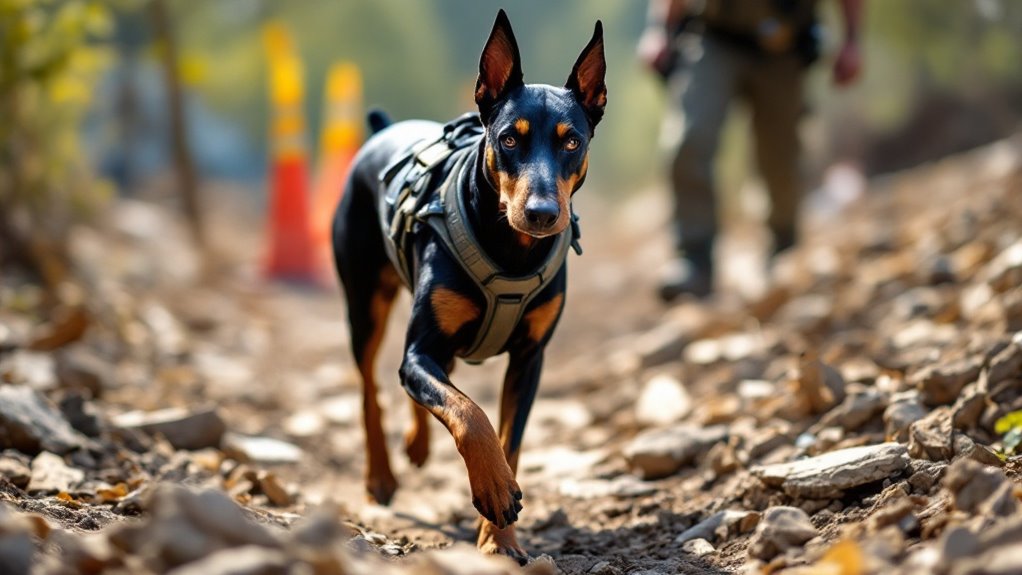
You can train your Doberman for search and rescue, but you’ll need to commit 600+ hours of structured training combined with weekly team sessions and individual handler work. Dobermans excel in SAR roles because their intelligence, athleticism, and work drive enable them to master complex scent-discrimination protocols across varied environments. Success requires formal temperament assessment, health clearance, and choosing a specialty—air scent, trailing, or human remains detection—that matches your dog’s strengths and your operational goals. Understanding the specific demands of each path will determine your training strategy.
- Key Takeaways
- What Makes Dobermans Ideal for Search and Rescue Work
- The 600+ Hour Commitment: Breaking Down SAR Training Time
- Taking the First Step: Assessing Your Dog and Choosing Your SAR Path
- The Four Core SAR Specialties: Which One Fits Your Goals?
- Air Scent and Live Find: Locating Missing People Fast
- Disaster Response: Searching Collapsed Structures
- Trailing: Following Scent Days or Weeks Old
- Human Remains Detection: Recovery Operations Across Varied Environments
- How Your Dog Signals a Find: Change of Behavior vs. Trained Response
- Choose Your Dog’s Alert Style: Active or Passive
- What Motivates Your SAR Doberman: Reward Selection for Alert Training
- Why Toys Beat Food for Training
- Obedience Requirements for Off-Leash Work
- The BOA Test: What Your Handler and Dog Must Demonstrate
- Teaching Scent Discrimination for Search Operations
- Search Patterns and Area Coverage Techniques in the Field
- Reading Scent Alerts: Recognizing Your Dog’s Odor Response
- Building Endurance for Extended Search Operations
- Training in Your Own Environment: How Virtual Sessions Build Real-World Skills
- Your SAR Training Schedule: Handler Credentialing and Team Certification
- Earning FEMA and NASAR Certification
- Connect With Your Local SAR Community
- Frequently Asked Questions
- Conclusion
Key Takeaways
- Dobermans excel in SAR due to intelligence, athleticism, and strong work drive enabling complex training mastery.
- SAR preparation requires 600+ hours of structured training across weekly team sessions and individual handler work.
- Air scent, trailing, and human remains detection specialties match different mission priorities and environmental conditions.
- Handlers must observe passively, use minimal commands, and allow dogs to work independently at nose level.
- Consistent Change-of-Behavior alerts and trained final responses establish reliable odor discrimination for field credibility.
What Makes Dobermans Ideal for Search and Rescue Work
Dobermans possess the foundational traits that search and rescue work demands: intelligence, athleticism, and a consistent drive to work.
Dobermans bring the intelligence, athleticism, and work drive that search and rescue operations fundamentally require.
You’ll find that their quick learning ability and exceptional problem-solving skills enable them to master complex TRAINING protocols, from air scenting to trailing techniques.
Their versatility allows you to deploy them across demanding environments—forests, rough terrain, collapsed structures, and water—supporting both live-find and human remains detection operations.
When you condition a Doberman to proper fitness standards, including agility work and healthy body composition, the breed sustains the endurance required for intensive Search and Rescue Dog preparation, which typically involves 600+ hours and weekly multi-hour sessions.
This combination of intelligence, athleticism, and work ethic makes the Doberman reliably suited for operational SAR deployment.
The 600+ Hour Commitment: Breaking Down SAR Training Time
Recognizing that a Doberman has the innate capacity for search and rescue work is one thing; actually building that capacity into reliable, deployable skill is another.
You’ll need to commit to 600+ hours of structured training to achieve basic operational competency, a benchmark that reflects the real demands of field work. Your search and rescue K-9 dog is trained through a combination of weekly team sessions—typically 4–7 hours—plus 10–20 hours of individual handler-dog work. This sustained effort develops scent discrimination, tracking, area-search patterns, and scenario-based readiness.
Training classes and mentoring partnerships accelerate your progress while ensuring you meet certification standards.
Consistency matters; ongoing weekly training maintains and sharpens skills well beyond initial certification, keeping your team deployment-ready year after year.
Taking the First Step: Assessing Your Dog and Choosing Your SAR Path
Before you commit to the 600+ hours required for SAR training, you’ll need to verify that your Doberman actually possesses the traits that make search and rescue work feasible. Begin with a formal temperament evaluation that assesses your dog’s play style, motivation, and resilience under stress, since these predictors determine success more reliably than intelligence alone.
Confirm your dog meets basic health standards, including appropriate body condition, musculoskeletal soundness, and cardiac clearance, because rescue work demands sustained endurance.
Run preference tests using toys and food to identify your dog’s highest-value reward, which becomes the foundation for consistent DOG TRAINING focus.
Finally, evaluate which SAR specialty—Air Scent, Trailing, or Human Remains Detection—aligns with your dog’s natural instincts and strengths, ensuring both capability and compatibility for successful Search and Rescue deployment.
The Four Core SAR Specialties: Which One Fits Your Goals?
When you’re selecting your Doberman’s SAR specialty, you’ll find that wilderness area recovery operations and urban disaster rubble searches represent two fundamentally different operational environments, each demanding distinct handler skills and dog capabilities.
Wilderness searches require your dog to cover expansive terrain quickly using air scent methods, whereas disaster operations place your dog in confined, hazardous structures where precise directional control and steady obedience become critical to both safety and success.
Understanding these environmental differences will help you align your training commitment with the specific scenarios where you’ll deploy your dog.
Wilderness Area Recovery Operations
Selecting a search and rescue specialty requires understanding how each discipline approaches the fundamental challenge of locating missing persons, and your choice will shape everything from your training timeline to your dog’s working methods and the environments where you’ll operate.
For wilderness area recovery operations, you’ll likely focus on air scent or trailing methods depending on your mission priorities. Air scent handlers deploy their Dobermans across expansive terrain to rapidly cover ground and locate live finds through airborne odor detection. Trailing specialists take a scent article and follow a specific person’s ground trail to establish direction of travel.
HRD teams, conversely, concentrate on locating human remains in outdoor settings, supporting recovery and forensic investigations across varied wilderness landscapes.
Urban Disaster Rubble Searches
If you’re drawn to high-stakes work where your Doberman can make an immediate difference in life-or-death situations, urban disaster rubble searching offers a specialized path that demands exceptional preparation but delivers profound purpose.
Disaster-trained Dobermans locate live victims in collapsed structures using directional control and hand signals from distances where handlers maintain safety. Your dog must navigate unstable surfaces, tunnels, and elevated platforms with agility and confidence. A reliable final response—such as stay-and-bark or a nose-poke down-stay—signals victim location without disturbing debris.
What you’ll need:
- Hundreds of hours of training plus BOA-style obedience standards
- Cross-training in Human Remains Detection for deployment versatility
- Integration with recognized task forces and credentialing bodies
- Exceptional fitness and hazard-environment competency for both handler and dog
Air Scent and Live Find: Locating Missing People Fast
You’ll master air scent work by building three interconnected skills: teaching your Doberman to cover large search areas efficiently through off-leash grid patterns, conditioning reliable alert behaviors when the dog encounters human scent, and maintaining clear communication with your handler position so you can respond quickly when your dog signals a find.
Each element depends on the others—rapid area coverage means nothing without a consistent trained final response, and even the best alert becomes unreliable without practiced handler coordination across distance and changing weather.
Your training foundation rests on high-value rewards, off-leash obedience standards, and hundreds of hours of repetition that builds both endurance and the structure your dog needs to perform under pressure.
Rapid Area Coverage Techniques
Through rapid area coverage techniques, air-scent Dobermans locate missing people by quartering upwind across large, forested, or difficult terrain, using airborne human scent rather than following a ground trail to find live subjects quickly. You’ll deploy your dog in systematic search patterns that maximize coverage while maintaining off-leash directional control at distance.
- Your dog covers expansive sectors by working upwind, catching human scent particles airborne
- You read wind direction and terrain to position your dog strategically for peak scent detection
- Your dog’s high motivation and endurance allow sustained searches across challenging landscapes
- You combine air-scent techniques with trailing and human remains detection search methods for consolidated operations
This structure guarantees your Doberman reaches maximal odor concentration before indicating, translating training reliability into actual field performance.
Scent Detection and Alert Training
Building reliable scent detection and alert responses forms the foundation of air-scent operations, because your Doberman’s ability to distinguish true human odor from transient scent particles directly determines search effectiveness and field credibility.
You’ll establish consistent change-of-behavior (CoB) alerts—either active responses like barking and digging or passive responses such as sit-stays and nose pokes—so you can confidently identify genuine finds.
Training emphasizes repeatability across varied conditions, reinforcing your dog’s discrimination between target odor and environmental background scent.
Reward selection proves critical here; you must identify your Doberman’s preferred paycheck through preference testing, then deliver it reliably whenever your dog locates source odor and returns with the trained final response.
Consistency builds confidence in both handler and dog.
Handler Communication and Coordination
Once your Doberman demonstrates reliable scent detection and a consistent trained final response in controlled settings, the search environment demands a different skill: handler communication that keeps pace with your dog’s speed and decision-making across distance and terrain.
You’ll rely on trained directionals and long-line control to guide your dog across forested or difficult terrain while allowing quartering and rapid location of live subjects.
Monitoring observable Change of Behavior (CoB) serves as an early indicator before a formal alert, enabling you to mark GPS waypoints and radio your team immediately so resources concentrate on the find.
Your dog’s final response (TFR)—whether sit-stare or bark-stay—signals the source or strongest odor.
- Deploy directionals to guide direction and quartering patterns
- Recognize CoB as early alert precursor
- Mark waypoints immediately upon observation
- Maintain radio communication with incident command
Disaster Response: Searching Collapsed Structures
When disaster strikes and structures collapse, search and rescue teams deploy specially trained Dobermans to locate survivors and recover remains in environments that’d be dangerous or impossible for handlers to search thoroughly on foot. Disaster Dobermans complete rigorous training programs that prepare them for live-find and human-remains-detection roles, conditioning them for unstable footing, confined spaces, and heavy equipment.
The dog’s behavior remains controlled through hand signals and directional commands, allowing handlers to direct searches from safer distances. You’ll find that trained final responses—either active or passive—occur only when the dog detects the strongest odor source, preventing false alerts in complex debris fields where multiple scents compete. This consistency and reliability makes Dobermans invaluable during hurricanes and major structural emergencies.
Trailing: Following Scent Days or Weeks Old
You’ll find that scent article selection forms the foundation of reliable trailing work, since contamination from multiple handlers or improper storage can compromise your dog’s ability to discriminate the target odor from background scents.
Environmental factors like temperature, humidity, wind direction, and terrain complexity markedly influence how long a scent trail remains viable and how your dog must adjust their search strategy, which means you’ll need to document these conditions carefully during training and deployment.
Your patience and clear communication—reading your dog’s body language, maintaining consistent directional cues, and trusting their work on aged trails—determine whether you can successfully navigate the unpredictable variables that define real search scenarios, where trails may be days or weeks old before your team arrives on scene.
Scent Article Selection Matters
Building a trailing dog’s ability to follow scent that’s days or weeks old hinges on selecting articles that’ll preserve human odor through extended environmental exposure. When you’re developing your training plan for a service dog or operational team, you’ll need articles with prolonged, consistent contact rather than briefly handled objects.
Worn clothing from different body areas creates a wide range of scent profiles that strengthen your dog’s detection reliability.
- Use socks, t-shirts, and hats worn directly against skin for superior odor retention
- Select 3–5 articles from different body areas to build composite scent profiles
- Store articles separately in breathable paper bags to prevent cross-contamination
- Include control blanks and decoy articles during training to verify target odor detection
This structured approach guarantees consistency and reliability as you progress toward operational readiness.
Age and Environmental Factors
As your Doberman matures and gains scent-discrimination experience, the age of a trail becomes a critical variable that shapes both search strategy and realistic expectations. Environmental conditions—temperature, humidity, wind, and precipitation—dramatically affect how long scent persists on the ground.
Cool, moist conditions and sheltered terrain like leaf litter preserve scent longer than hot, dry, or exposed surfaces. A new dog requires progressive conditioning before attempting older trails, which demands months of focused training at a training center or through virtual training modules.
You’ll adjust your search pace and pattern accordingly, recognizing that heavily trafficked urban areas degrade scent faster than shaded forests. Cross-referencing with air-scent teams strengthens reliability when conditions complicate detection.
Handler Communication and Patience
When trailing scent that’s days or weeks old, the handler’s role shifts fundamentally from active direction to disciplined observation and restraint. You must allow your Doberman to work independently at its nose, trusting the dog’s natural abilities while resisting the urge to overcorrect or redirect unnecessarily. Overcorrection can break a fragile, aged trail that took hours or days to establish. Instead, use only subtle hand signals and directional cues when guidance becomes essential.
Your patience directly determines your dog’s success:
- Observe without interfering, letting the dog follow scent concentration at its own pace
- Use minimal verbal commands, relying on body language and positioning
- Resist redirecting unless the dog clearly loses the trail
- Maintain consistency in your calm demeanor, which reinforces your dog’s confidence
This restraint builds reliability and strengthens your trailing partnership.
Human Remains Detection: Recovery Operations Across Varied Environments
Human Remains Detection (HRD) teams operate across diverse environments—outdoors, vehicles, collapsed structures, and water—locating both recent and centuries-old remains that visual searches can’t find. Your Doberman’s training focuses on recognizing decomposition scents and discriminating them from background odors, which allows reliable alerts in challenging conditions.
During disaster deployments, you’ll work your dog at a distance using hand signals while maintaining strict safety awareness in unstable debris fields. Your handler role requires careful documentation of each alert and preservation of associated evidence for forensic analysis.
The consistency of your dog’s trained final response—the specific behavior indicating maximal scent concentration—distinguishes HRD work from live-find searches. This reliability makes your team invaluable for cold-case investigations and historical recoveries where traditional methods fail.
How Your Dog Signals a Find: Change of Behavior vs. Trained Response
You’ll need to distinguish between three distinct signals your Doberman gives during search work: a change of behavior, an alert, and the trained final response, each representing a different level of detection confidence and intentionality.
Dobermans communicate detection through three distinct signals: behavioral changes, alerts, and trained final responses, each indicating different confidence levels.
A change of behavior—sudden sniffing focus, head tilts, or increased intensity—indicates your dog has detected an anomalous odor above baseline, yet hasn’t confirmed the source.
An alert represents a consistent, previously reinforced behavior like staring or sitting that signals detection.
Your trained final response remains the most reliable indicator: an active behavior such as barking or scratching, or a passive response like nose-poking.
- Changes of behavior suggest preliminary detection only
- Alerts indicate consistent, reinforced recognition
- Trained final responses pinpoint exact odor sources
- Timing prevents false positives during operations
Choose Your Dog’s Alert Style: Active or Passive
You’ll need to decide whether your Doberman’s alert style should be active—such as barking, scratching, or tugging—or passive, such as sitting, lying down, or holding a nose-poke, and this choice depends on your dog’s natural temperament, your operational specialty, and the environments where you’ll deploy.
Active alerts work well for wilderness and open-area searches where clear, audible signals help you locate your dog quickly from a distance, while passive alerts serve better in confined spaces, disaster scenes, or human remains detection work where noise or disturbance could compromise evidence or upset victims.
Matching your dog’s alert style to these practical demands, combined with your dog’s own behavioral tendencies and your agency’s certification requirements, guarantees that you’ll develop a reliable, consistent response that sustains your dog’s motivation through extended searches.
Active Alert Behaviors
Active alerts—overt behaviors like barking, scratching, or toy retrieval—form the foundation of a clear communication system between your Doberman and you during search operations. These conspicuous signals work well in large-area searches because you can see or hear them from a distance, confirming a live-find without ambiguity.
Your training must establish strict timing so your dog doesn’t indicate until reaching the source or strongest odor concentration, preventing false positives. Reward immediately with your dog’s highest-value payoff identified through preference testing.
Key considerations for active alerts:
- Require strong off-leash obedience and handler control
- Enable unmistakable notifications in wilderness or disaster scenarios
- Demand consistent pairing with handler cues
- Build reliability through high-reward reinforcement protocols
Active alerts demand commitment but deliver dependable, distance-capable communication your team can trust.
Passive Alert Behaviors
While active alerts work well for distance communication in open searches, passive alerts offer a fundamentally different approach that prioritizes scene preservation and handler precision. You’ll train your Doberman to signal detection through controlled behaviors—sit, down-stay, or nose poke—that minimize disturbance, particularly valuable in Human Remains Detection and sensitive evidence scenarios. This method demands dogs with strong food or toy motivation but lower barking tendencies, qualities you’ll identify during temperament testing. You’ll emphasize long-duration holds during training, requiring your dog to maintain the alert until you provide reward or release, ensuring clear communication and reliability. Operational success depends on your dog alerting only at source or maximal odor concentration, reinforced through consistent reward cycles and regular retention drills.
| Training Focus | Handler Requirement |
|---|---|
| Long-duration holds | Precise timing and release |
| Scene preservation | Minimal disturbance protocol |
| Odor specificity | Maximal concentration alerts |
Matching Style To Dog
Selecting an alert style isn’t about picking the method that sounds easiest or most impressive—it’s about matching the behavioral strengths of your individual dog to the operational demands you’ll actually face. Your Doberman’s natural temperament, drive level, and physical capabilities should guide your choice between active and passive responses.
Consider these factors when determining the best fit:
- Energy and vocalization tendencies: Dogs with high prey drive and natural barking instincts excel at active alerts, while calmer, focused dogs perform better with passive stays
- Environmental suitability: Outdoor disaster work benefits from active signals; indoor forensic searches require passive restraint
- Handler control proficiency: Active alerts demand reliable off-leash obedience and directional handling skills
- Reliability foundation: Build consistency through preference testing before committing to either style
Your dog’s success depends on alignment between alert type and individual capability.
What Motivates Your SAR Doberman: Reward Selection for Alert Training
The success of your SAR Doberman’s alert training depends fundamentally on identifying what genuinely motivates your individual dog, since what drives one Doberman to search reliably may leave another indifferent. Conduct a structured preference test using toys and high-value food to establish your dog’s primary reinforcer before beginning alert work. This “paycheck” becomes your immediate reward for the trained final response—whether active behaviors like stay-and-bark or passive signals like nose poke—ensuring your dog reliably indicates at odor source.
| Training Phase | Reward Type | Delivery Method | Frequency | Duration |
|---|---|---|---|---|
| Initial Association | High-value toy/food | Extended play bouts | Every alert | 2–3 minutes |
| Early Competency | Mixed rewards | Rapid sequences | Intermittent | 1–2 minutes |
| Maintenance | Variable reinforcement | Brief play/treats | Random schedule | 30 seconds |
| Peak Performance | Situational rewards | Handler preference | Strategic | Varied |
| Reassessment Checkpoints | Preferred items | Rotated methods | As needed | Baseline |
Rotate rewards and delivery methods to sustain search motivation and prevent satiation during extended wilderness sessions. Reassess reward efficacy after major career shifts, since your Doberman’s preferences shift with age, fitness, and accumulated experience.
Why Toys Beat Food for Training
Most Dobermans display a strong natural drive to chase, catch, and possess toys—a preference that you’ll identify during your initial preference testing—making play-based rewards fundamentally more motivating than food for SAR scent work.
Toys deliver immediate, high-energy reinforcement that sustains the intense focus your dog needs across 4–7+ hours of weekly training and the 600+ hours required for operational competency.
Food handling introduces pauses and scent contamination risks that compromise odor association during air-scent, trailing, and HRD work, whereas toys preserve the integrity of your training structure.
Play-based rewards also support reliable, distinct Trained Final Responses—such as bring-to-handler or bark celebrations—that you’ll recognize clearly in field conditions, establishing consistency between training and deployment performance.
- Toys maintain motivation without satiety
- Play rewards prevent odor contamination
- Active responses remain sharp and recognizable
- Endurance builds through high-energy reinforcement
Obedience Requirements for Off-Leash Work
Before your Doberman can work off-leash in search and rescue operations, you’ll need to establish obedience that goes far beyond basic commands—it requires demonstrated control and reliability through formal evaluation.
The BOA test assesses your dog’s ability to maintain a five-minute down-stay and respond instantly to emergency stops, proving they’ll hold position and obey critical cues under pressure.
You’ll also verify off-leash readiness by working through crowded environments, confirming your dog won’t engage, bark, or interfere with people or other dogs.
Sustained reliability demands ongoing commitment: plan for 10–20 hours of weekly individual training plus team sessions.
This consistency preserves the obedience foundation necessary for safe, dependable deployments in unpredictable search and rescue situations.
The BOA Test: What Your Handler and Dog Must Demonstrate
Once you’ve established your dog’s foundational obedience, you’ll face the BOA test—a structured evaluation that assesses your team’s readiness for off-leash search and rescue work by measuring behavior, obedience, and agility under realistic operational conditions.
The BOA test evaluates handler-dog team readiness for off-leash search and rescue through behavior, obedience, and agility assessments in realistic operational conditions.
During this assessment, you’ll demonstrate your ability to maintain control while your dog performs required tasks:
- Loose-leash walking and maneuvering through crowded spaces with other dogs and people present
- Emergency stop response and a five-minute down-stay to show reliability
- Jumping onto surfaces at least 3 feet high and traversing unstable terrain
- Walking across narrow planks, horizontal ladders, and traveling through tunnels without visible exits
Your team’s successful BOA performance establishes the baseline for certification and public deployments, protecting both your dog’s fitness and handler safety during operational SAR missions.
Teaching Scent Discrimination for Search Operations
You’ll build your Doberman’s scent discrimination foundation by first identifying which rewards—toys or food items—genuinely motivate your dog through structured preference testing, then consistently pairing those high-value rewards with the target human odor so your dog learns to associate that specific scent with its paycheck.
Your dog must learn to distinguish the target scent from multiple distractors through progressive training arrays, starting with two-choice scenarios and advancing to three-choice setups where your dog practices alerting only to the correct odor while ignoring similar or competing scents.
This structured approach to odor recognition, combined with careful monitoring of your dog’s responses across varied conditions, establishes the discrimination consistency and reliability that operational search work demands.
Odor Recognition Fundamentals
Teaching a Doberman to recognize and reliably alert on target odor is the foundation of all search and rescue work, and it requires a structured, systematic approach that builds discrimination skills gradually from simple to complex.
You’ll establish a clear trained final response—either active or passive—that your dog performs consistently at the odor source, then reinforce this behavior with high-value rewards determined through preference testing.
Your training progresses through deliberate stages:
- Introduce a single target odor in controlled settings before advancing to multiple distractions
- Present non-target controls, blank hides, and decoy odors to prevent false alerts
- Measure reliability through blinded trials, targeting ≥90% accuracy
- Rotate reward types and conduct periodic sterile trials to maintain discrimination fidelity
This foundation guarantees your Doberman performs reliably across varying environments and conditions.
Scent Discrimination Training Methods
Building reliable scent discrimination requires a structured progression that moves your Doberman from simple paired choices to complex, real-world scenarios while maintaining consistent accuracy above 80% throughout each stage. You’ll begin by presenting paired odor boxes—target versus distractor—and reinforce only correct indications until your dog reliably identifies the target odor across randomized trials.
As proficiency develops, gradually introduce multiple distractors, variable containers, and increased distances. You’ll also separate air-scent and trailing contexts, teaching open-area hides with wind variability for air-scent work, then imprinting on scent articles for trailing discrimination across aged trails. Rotate target presentations, handlers, and locations regularly, incorporating blind trials to prevent handler cueing. Track success rates session-by-session, ensuring consistency before advancing difficulty levels while maintaining motivation through high-value rewards and appropriate repetition limits.
Building Detection Reliability
Detection reliability—the ability of your Doberman to consistently and accurately identify target human scent under operational conditions—rests on a foundation of structured, evidence-based training that moves deliberately from controlled exercises to real-world complexity.
You’ll establish this reliability through systematic progression and objective measurement rather than assumption or intuition.
Your approach should include:
- Progressing from simple two-item odor stacks to multiple distractors, requiring your dog to perform a trained final response only at the strongest scent source
- Using controlled blind setups and double-blind testing with randomized hide placements to prevent handler cueing and build independent decision-making
- Training across varied substrates, weather, and terrain—woods, rubble, water edges—while gradually increasing search area size
- Measuring reliability objectively through percent correct alerts, false positives per hour, and time-to-find metrics, requiring sustained >90% accuracy before advancement
Search Patterns and Area Coverage Techniques in the Field
Once you’ve established a search area, your Doberman’s effectiveness depends on systematic coverage patterns that align scent detection with terrain and wind conditions.
Your Doberman’s search effectiveness hinges on systematic coverage patterns that integrate scent detection with terrain and wind conditions.
In open terrain, you’ll space line searches 10–30 meters apart, widening to 30–100 meters in dense woods as visibility decreases.
For larger forested areas, grid or quadrant patterns with handlers spaced 50–100 meters apart maximize scent coverage while reducing overlap.
When you’re starting from a last-known point, concentric or fan searches expand outward in gradually widening arcs.
During rubble operations, you’ll tighten spacing to 2–5 meters with short, directed sweeps.
Throughout all patterns, you must continuously monitor wind direction, terrain features, and scent corridors like gullies or trails, adapting dynamically to maintain your dog’s endurance and search reliability.
Reading Scent Alerts: Recognizing Your Dog’s Odor Response
Your Doberman’s value in search and rescue hinges entirely on your ability to recognize when he’s detected human odor versus when he’s simply investigating his environment, and this distinction requires you to understand the progression from initial scent contact to a trained final response.
A Change of Behavior signals your dog’s first encounter with anomalous odor. You’ll observe:
- Sudden head lift or intensified sniffing indicating scent detection
- Quartering movements or purposeful locomotion toward a concentrated source
- Consistency with previously reinforced Alert behaviors rather than transient curiosity
- Delayed Final Responses only after your dog localizes the odor plume
Timing matters critically. Air-scent Dobermans often give transient responses while sweeping areas, committing to sustained alerts only when they’ve pinpointed the source. Record and reward clear alerts based on your dog’s individual payoff profile to strengthen reliable, repeatable odor-response signaling.
Building Endurance for Extended Search Operations
Recognizing your dog’s scent alert reliably sets the foundation for what comes next: building the physical and aerobic capacity he’ll need to sustain that detection work over hours, not minutes.
You’ll progress gradually toward 4–7 hours weekly of team training, supplemented by 10–20 hours of individual conditioning over months.
Incorporate interval-style scenting sessions that alternate high-intensity air-scent or trailing work with active recovery, strengthening aerobic capacity without overloading his joints.
Add sport-specific obstacles—3-foot climbs, unstable surfaces, tunnels—to develop proprioception and search-stamina.
Cross-train with controlled hill repeats, swimming, and core work while monitoring his Body Condition Score and cardiac health through screenings.
This structured approach prevents injury while building the durability extended operations demand.
Training in Your Own Environment: How Virtual Sessions Build Real-World Skills
Through remote instruction conducted in your dog’s familiar terrain, you’ll train scent discrimination, tracking, and search patterns while reducing the stress that often accompanies unfamiliar environments, which in turn improves how those skills translate when your Doberman works actual wilderness searches.
Remote instruction in familiar terrain builds scent work skills while reducing stress, translating better to real wilderness searches.
Your trainer provides live, interactive coaching during weekly check-ins, allowing you to adjust techniques in real time and progress toward operational goals like air-scent or trailing specialties. This personalized feedback establishes reliability and consistency in your dog’s responses.
Key benefits of training in your own environment:
- Builds confidence through repetition in known territory
- Strengthens handler-dog communication patterns and cues
- Reduces anxiety that interferes with scent work
- Creates foundation for real deployment success
Your SAR Training Schedule: Handler Credentialing and Team Certification
Before your Doberman team can deploy on actual searches, you’ll need to complete a structured path that combines formal credentialing, skill demonstration, and ongoing education. Obtain credentials from recognized bodies like NASAR, NDPTC, or the International Police Work Dog Association, which guarantees you’ve received training in search techniques and evidence preservation.
Your team must pass controlled field qualification tests that evaluate trailing, air-scent, disaster, or HRD competencies, producing portable credentials for every deployment. You’ll complete over 600 hours of combined training across varied weather and terrain, typically adding 4–7 group hours plus 10–20 individual hours weekly. Maintain certification through continuing education and regular mentoring with established teams, keeping your skills current and reliable.
Earning FEMA and NASAR Certification
To deploy your Doberman on federal or state incidents, you’ll need to complete FEMA’s Incident Command System courses (ICS-100, -200, and IS-700) alongside NASAR credentialing programs like SARTECH I, II, and III, which establish your handler competence in search techniques, safety, and evidence preservation.
Your dog must pass formal field qualification tests in your team’s specialty—whether air scent, trailing, disaster, or human remains detection—administered by recognized credentialing bodies that verify both handler control and canine reliability.
After certification, you’re responsible for maintaining active status through documented training logs, consistent practice to meet operational standards like off-leash control and extended down-stays, and regular renewal of credentials to keep your team deployment-ready.
Certification Requirements And Standards
When your Doberman search and rescue team pursues formal FEMA or NASAR certification, you’ll enter a structured credentialing process that demands rigorous, documented proof of competency across multiple dimensions—obedience, physical capability, specialty skills, and field experience.
You’ll need to demonstrate consistent performance through 600+ hours of multi-terrain training and verified deployments, establishing reliability under examiner scrutiny.
Your team must pass BOA-style obedience tests and present health documentation, including acceptable Body Condition Score and often cardiac screening.
Examiners assess specialty-specific skills—air-scent area searches, trailing across extended timeframes, or human remains detection in varied environments—confirming your handler-team readiness for operational work.
- Extensive documented training hours across all weather conditions
- BOA obedience testing and agility demonstrations
- Health and fitness prerequisites with cardiac screening eligibility
- Specialty skill verification under certified examiner assessment
Training Pathways To Deployment
Your Doberman’s progression from foundational obedience to deployment-ready status follows a structured pathway that typically demands 600+ hours of combined training across varied terrain and weather conditions.
You’ll balance group sessions, running 4–7 hours weekly, with intensive individual K-9 work totaling 10–20+ hours per week.
To earn FEMA-recognized credentials, you must complete NASAR or FEMA courses such as Search Technician, then pass formal field qualification tests administered by credentialing bodies like NASAR, IPWDA, or regional state SAR councils.
Your dog must demonstrate BOA-level obedience and fitness—including loose-leash walking, five-minute down-stays, emergency stops, and agility tasks—before achieving off-leash certification and operational deployment eligibility.
Maintaining Active Certification Status
Achieving FEMA or NASAR certification represents a significant milestone, but it’s only the beginning of a longer commitment—maintaining that active status requires consistent effort, documented proof of competency, and a structured approach to ongoing training and evaluation.
You’ll need to complete formal requalification tests regularly, demonstrating your specialty under controlled field conditions while maintaining handler continuing education through approved courses and documented operational hours.
Your maintenance responsibilities include:
- Logging 4–10+ weekly training hours and 600+ cumulative hours toward operational readiness
- Passing BOA proficiency assessments covering loose-leash control, five-minute down-stays, emergency stops, and off-leash agility
- Keeping current medical and fitness documentation, including Body Condition Score and recommended Holter cardiac screening
- Maintaining organized records of certifications, deployments, and training for deployment verification
Connect With Your Local SAR Community
To build a foundation in search and rescue work, you’ll need to connect with established teams and organizations that can provide structure, mentoring, and credibility in the field. Joining local SAR teams like the Ohio Special Response Team or NASAR-affiliated groups gives you access to handlers who understand what your Doberman needs to succeed. These organizations offer regular training schedules—typically 4–7 hours weekly for K-9s, plus 10–20 hours of individual work—that create the consistency your dog requires for reliability.
| Resource Type | Examples | Benefits |
|---|---|---|
| Local Teams | OSRT, NASAR groups | Weekly training, mentoring, credentialing |
| Regional Courses | FEMA, NDPTC, NCJTC | Handler certification, evidence standards |
| Breed Networks | UDC, certified SAR lists | Health screening, Doberman-specific guidance |
Volunteering at multi-discipline SAR events—disaster drills, trailing exercises, and HRD searches—lets you work alongside experienced teams and learn real-world protocols directly.
Frequently Asked Questions
Are Dobermans Good for Search and Rescue?
Yes, you’ll find Dobermans excel in search and rescue work. You’re looking at a breed that combines intelligence, agility, and strong work ethic—traits that make them effective in disaster, trailing, and air-scent operations when properly trained.
What Is the 3-3-3 Rule for Rescue Dogs?
You’d think survival was complicated, but it’s not. You’ve got three minutes without air, three hours in extreme temperatures, and three days without water—that’s how you’ll prioritize your rescue dog’s search efforts efficiently.
How Much Does It Cost to Train a Dog for Search and Rescue?
You’ll invest over 600 training hours costing hundreds to thousands of dollars. Factor in certification exams, specialized equipment, veterinary care, and ongoing weekly sessions. Annual operational expenses continue markedly beyond initial training.
Why Don’t Police Use Dobermans Anymore?
You’ll find police departments abandoned Dobermans because German Shepherds and Belgian Malinois offered superior availability, standardized breeding, consistent temperament, and established bite-work pedigrees. Media stereotypes and health concerns also discouraged adoption.
Conclusion
You’ve invested hundreds of hours training your Doberman through rigorous SAR protocols, yet your dedication mirrors that of search dogs from centuries past. Your commitment to structure, consistency, and reliability transforms your dog into a trustworthy handler partner. You’re now equipped to locate missing people effectively, certified through FEMA and NASAR standards. You’ve joined a community bound by purpose, where your Doberman’s skills serve genuine human need.