Affiliate Disclosure: This post may contain affiliate links. If you purchase through them, DobermanSmarts may earn a small commission at no additional cost to you. We only recommend products, tools, and resources we genuinely believe can help Doberman owners.
You can train your Doberman effectively using operant conditioning, which teaches your dog that specific behaviors produce predictable consequences. This approach works particularly well for Dobermans because they’re highly intelligent, learning commands in just five to ten repetitions, and they’re emotionally sensitive to training methods. Rather than using harsh corrections that damage trust, you’ll combine positive reinforcement—rewarding desired behaviors with treats or praise—with negative punishment, which removes valued rewards when your dog acts inappropriately. Consistency and immediate rewards strengthen the connection between actions and outcomes, building reliability while maintaining the bond with your dog. Understanding how to tailor this framework to your individual Doberman’s preferences will greatly improve your training success.
- Key Takeaways
- What Is Operant Conditioning and Why It Matters for Dobermans
- How Do Dobermans Learn Differently Than Other Breeds?
- The Four Quadrants of Operant Conditioning Explained
- Positive Reinforcement: Building Confidence in Your Doberman
- Negative Punishment: Removing Rewards to Discourage Behavior
- Why Do Modern Trainers Avoid Positive Punishment?
- Common Mistakes Sabotaging Your Doberman’s Training
- When Your Doberman Resists: Adapting Techniques for Individual Temperaments
- Operant Conditioning in Action: Real Doberman Training Examples
- Why Positive Reinforcement Creates Stronger Bonds With Your Doberman
- Why Operant Conditioning Works for Dobermans: The Science
- Building a Balanced Doberman Training Plan
- What to Expect: Timeline and First-Week Foundations
- Getting Started: Your First Week of Operant Conditioning Training
- Frequently Asked Questions
- Conclusion
Key Takeaways
- Dobermans learn commands in 5-10 repetitions due to high intelligence, requiring fewer repetitions than most dog breeds for mastery.
- Positive reinforcement builds trust and cooperation with sensitive Dobermans, while harsh corrections damage bonds and inhibit learning effectiveness.
- Use attention withdrawal for unwanted behaviors by turning away and ignoring until calmness returns, then resume interaction.
- Combine multiple operant conditioning quadrants—positive reinforcement, negative reinforcement, positive punishment, and negative punishment—for comprehensive training success.
- Establish consistent routines with 5-10 minute training sessions using breed-specific reinforcers to create reliable behavior-consequence associations.
What Is Operant Conditioning and Why It Matters for Dobermans
When you’re training a Doberman, you’re fundamentally teaching the dog that certain behaviors produce specific consequences, and this cause-and-effect relationship is the foundation of operant conditioning.
This learning process enables your Doberman to modify behavior based on outcomes, creating predictable patterns that strengthen over time. Understanding operant conditioning matters because it gives you a structured, reliable framework for dog training.
When you apply positive reinforcement—such as treats or praise following desired actions—you increase the likelihood your Doberman will repeat those behaviors. This connection between action and reward builds stronger learning pathways than inconsistent or unclear training methods.
How Do Dobermans Learn Differently Than Other Breeds?
You’ll find that Dobermans learn through a combination of high intelligence and strong prey drive, which means they’re naturally motivated to pursue rewards and respond quickly to structured training methods that tap into these instincts.
Their sensitivity to training approaches sets them apart, since they don’t thrive under harsh corrections like some breeds do; instead, they develop stronger associations with desired behaviors when you pair commands with positive reinforcement in a consistent, trust-based framework.
Understanding these breed-specific behavioral traits—including their enthusiasm to please balanced with a shorter attention span—allows you to design training sessions that work with their natural tendencies rather than against them.
Intelligence And Prey Drive
Because Dobermans possess both exceptional intelligence and a pronounced prey drive, they learn through operant conditioning in ways that differ meaningfully from many other breeds.
You’ll find that their intelligence accelerates learning, while their prey drive shapes how they respond to training methods. Consider these key aspects of their learning style:
- They require fewer repetitions to master commands, absorbing instructions quickly through their cognitive abilities.
- They respond powerfully to movement-based training that channels their natural hunting instincts.
- They need consistent positive reinforcement paired with mental challenges to maintain focus.
You can leverage their intelligence by designing behavior protocols that incorporate problem-solving elements.
Their prey drive makes them particularly responsive to operant conditioning techniques emphasizing chase and movement.
Without adequate mental stimulation and structured expectations, however, they’ll become bored and distracted, undermining training success.
Sensitivity To Training Methods
Dobermans’ exceptional intelligence and emotional sensitivity mean they’ll respond quite differently to various training approaches than many other breeds, requiring methods that build trust rather than rely on force or fear.
Harsh corrections damage the bond you’ve established with your dog and create anxiety that actually inhibits learning rather than advancing it.
Your Doberman thrives on positive reinforcement, which leverages their natural motivation to please and their desire for clear structure.
When you combine consistency with reward-based methods, you create an environment where your dog feels secure enough to focus on learning.
This approach respects their sensitive nature while capitalizing on their considerable intelligence, producing better results than aversive techniques ever could.
Breed-Specific Behavioral Traits
While many dog breeds can adapt to various training methods, Dobermans learn in distinctly different ways that reflect their unique combination of intelligence, emotional sensitivity, and drive to work alongside their handlers. You’ll find that these dogs respond exceptionally well to positive reinforcement, yet they require a fundamentally different approach than many other breeds.
Their learning style centers on three key elements:
- Consistent structure that provides clear boundaries and predictable consequences
- Frequent, focused sessions that accommodate their high energy and sharp attention span
- Early socialization that shapes their protective instincts toward appropriate responses
Dobermans don’t simply follow commands; they seek partnership and reliability from their handlers. Understanding these breed-specific traits means you can design training methods that align with how they naturally process information and develop behavioral patterns.
The Four Quadrants of Operant Conditioning Explained
Understanding operant conditioning’s framework requires learning how four distinct quadrants work together to shape behavior, each defined by whether a stimulus is added or removed and whether the goal is to increase or decrease a behavior.
| Quadrant | Stimulus | Action | Result |
|---|---|---|---|
| Positive Reinforcement | Rewarding | Add | Increase behavior |
| Negative Reinforcement | Unpleasant | Remove | Increase behavior |
| Positive Punishment | Unpleasant | Add | Decrease behavior |
| Negative Punishment | Enjoyable | Remove | Decrease behavior |
You’ll use positive reinforcement when you offer treats to encourage sitting, negative reinforcement by loosening leash tension when pulling stops, and positive punishment with corrections for jumping. Each quadrant serves a specific purpose, creating structure and reliability in your Doberman’s training through consistency and clear consequences that your dog can understand and respond to.
Positive Reinforcement: Building Confidence in Your Doberman
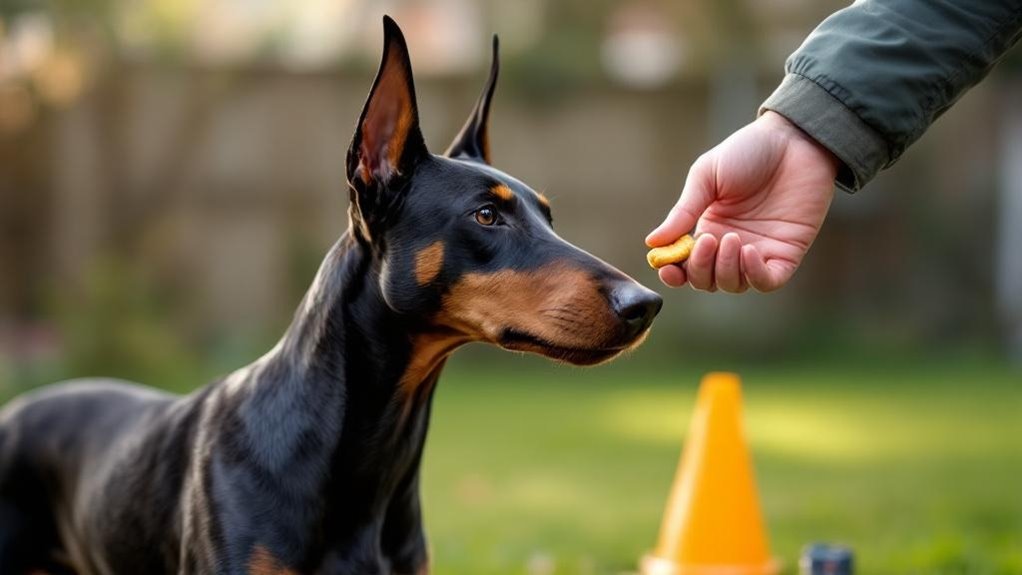
Because your Doberman’s brain responds powerfully to immediate rewards, positive reinforcement works by strengthening the connection between a desired behavior and something your dog values, whether that’s treats, praise, or toys.
When you understand this positive means your dog gets rewarded for doing right, you’re building confidence through success.
Understanding positive reinforcement builds your dog’s confidence through consistent success and reward.
Your training becomes more effective when you:
- Reward immediately after the desired behavior occurs, so your dog gets the connection between action and outcome
- Use consistent routines that establish clear expectations and reduce training anxiety
- Match rewards to your individual dog’s preferences for maximum engagement
Tailoring reinforcement to what motivates your specific Doberman guarantees reliable learning.
This approach fosters trust between you and your dog, encouraging both command mastery and overall good behavior through structured, predictable success.
Negative Punishment: Removing Rewards to Discourage Behavior
When your Doberman jumps on guests or displays unwanted behavior, you can withdraw attention or end playtime immediately, signaling that the action results in the loss of valued interaction.
This approach works because Dobermans, being deeply social dogs, recognize the connection between their behavior and the removal of rewards they cherish, making them more likely to avoid repeating the action.
You’ll find that combining attention withdrawal with removing access privileges—such as ending a training session or leaving the room—creates a clear, consistent structure that your dog can reliably understand and respond to.
Attention Withdrawal Techniques
One of the most straightforward ways to discourage unwanted behavior in your Doberman is to remove the very thing your dog values most—your attention and affection. This negative punishment approach, called attention withdrawal, capitalizes on your dog’s social nature to create meaningful behavioral change.
When your Doberman exhibits undesired behaviors like jumping or barking, implement these techniques:
- Turn away immediately and maintain silence
- Ignore the dog until they calm down completely
- Resume interaction only when behavior improves
Consistency matters tremendously; your withdrawal must be immediate and reliable so your Doberman connects the behavior directly to losing your presence.
Pair attention withdrawal with positive reinforcement for desirable actions, helping your dog clearly understand what earns rewards versus what creates isolation. This balanced structure prevents confusion and anxiety while building reliable obedience.
Removing Access Privileges
Extending negative punishment beyond attention alone gives you a more versatile toolkit for shaping your Doberman’s behavior, since your dog values multiple rewards that you can strategically control. When your Doberman exhibits unwanted behavior, you remove access to privileges they find rewarding, creating clear associations between their actions and loss of valued resources. This approach proves particularly effective because different dogs have distinct motivations.
| Reward Type | Behavior | Removal Strategy |
|---|---|---|
| Playtime | Excessive jumping | Suspend play sessions |
| Favorite toy | Destructive chewing | Restrict toy access |
| Outdoor access | Resource guarding | Limit yard time |
Consistency remains essential; applying the same consequence reliably helps your dog’s behavior improve through predictable structure. Balancing negative punishment with positive reinforcement guarantees your Doberman remains secure while learning appropriate conduct.
Why Do Modern Trainers Avoid Positive Punishment?
Why has positive punishment fallen out of favor among contemporary dog trainers, despite its historical use in canine training programs?
Modern trainers recognize that negative means damage the dog-handler relationship and produce counterproductive results. When you apply positive punishment, you create specific problems:
Modern trainers recognize that negative methods damage the dog-handler relationship and produce counterproductive results.
- Fear and anxiety that undermine trust and cooperation between you and your Doberman.
- Confusion about appropriate behaviors, since punishment doesn’t teach what you want instead.
- Defensive aggression, as your dog may respond to unpleasant stimuli with heightened reactivity.
Positive reinforcement means the behavior you want becomes more likely to repeat.
This approach fosters reliability and consistency without emotional cost. Contemporary ethical training principles prioritize your dog’s well-being through science-based methods that build genuine cooperation rather than compliance based on fear.
Common Mistakes Sabotaging Your Doberman’s Training
Several predictable errors undermine training progress with Dobermans, and you’ll likely encounter most of them during your work with your dog. These mistakes disrupt your dog’s learning and damage the trust you’ve built.
| Mistake | Problem | Solution |
|---|---|---|
| Inconsistent scheduling | Your Doberman becomes confused about expectations | Establish a reliable routine |
| Unintended reinforcement | You accidentally reward unwanted jumping or barking | Provide attention only for desired behaviors |
| Harsh punishment methods | Your dog develops fear and anxiety | Use only positive reinforcement with rewards |
You must avoid negative reinforcement and misapplied punishment, which erode your relationship with your dog. Ignoring small behavioral issues allows patterns to escalate dangerously. Additionally, failing to provide mentally stimulating activities creates boredom-driven destructive behaviors. Structure, consistency, and reliability form the foundation for effective operant conditioning with Dobermans.
When Your Doberman Resists: Adapting Techniques for Individual Temperaments
Resistance from your Doberman often signals something important about their mental state rather than willful disobedience, and understanding this distinction changes how you’ll approach training.
Your dog’s resistance may stem from fear, anxiety, or confusion about what you’re asking. To adapt your techniques for their individual temperament, you’ll need to:
- Clarify your commands using consistent cues and deliberate body language that reduce ambiguity.
- Assess whether anxiety drives the resistance, then adjust your pace and environment accordingly.
- Introduce positive reinforcement rewards that match your dog’s preferences, whether treats, praise, or play.
Operant Conditioning in Action: Real Doberman Training Examples
Once you’ve identified what drives your Doberman’s resistance and adjusted your approach accordingly, you’re ready to put operant conditioning into practice with concrete training techniques.
When teaching a sit command, you’ll use positive reinforcement by offering a treat immediately after your dog complies, strengthening the desired behavior.
For pulling during walks, you’ll apply negative reinforcement by loosening leash pressure when your Doberman relaxes, encouraging calm movement.
With unwanted mouthing, negative punishment works effectively—you’ll withhold attention by turning away, teaching your dog that hand contact ends social interaction.
Professional dog trainers emphasize that consistency matters greatly; your structured approach and reliable responses help your Doberman understand expectations clearly, building both obedience and trust between you.
Why Positive Reinforcement Creates Stronger Bonds With Your Doberman
When you reward your Doberman for desired behaviors, you’re doing more than teaching obedience—you’re building a foundation of trust that strengthens your relationship in measurable ways.
Positive reinforcement creates lasting emotional connections by establishing reliability and consistency in your interactions. Your dog learns to associate you with good outcomes, which reduces anxiety and fosters confidence.
This bond deepens through three key mechanisms:
- Your Doberman develops positive associations with training, making engagement voluntary rather than forced.
- Trust accumulates as your dog predicts rewarding outcomes from your presence and direction.
- Mutual respect emerges when your dog chooses cooperation over compliance.
When you focus on rewarding desired behaviors rather than punishing mistakes, you cultivate genuine partnership.
Your Doberman becomes more willing to explore new situations and try unfamiliar behaviors, knowing you’ll support those efforts. This cooperative dynamic creates the strong, reliable bond that defines effective long-term training.
Why Operant Conditioning Works for Dobermans: The Science
You’ll find that operant conditioning works exceptionally well for Dobermans because their natural intelligence and enthusiasm to learn enable them to make clear connections between their actions and the consequences that follow, creating a reliable structure for behavior modification.
Your Doberman’s responsiveness to both reinforcement and carefully applied aversive methods stems from their breed-specific traits—they’re driven to understand what you’re asking and motivated to comply when the communication is consistent and fair.
Rather than relying on harsh corrections, you’ll achieve faster, more lasting results by emphasizing positive reinforcement, which leverages their inherent desire for approval and strengthens the foundation of trust between you and your dog.
Doberman Intelligence And Learning
Dobermans’ position among the top ten most intelligent dog breeds provides the foundation for why operant conditioning works so effectively with this breed, and understanding this connection reveals the science behind their training success.
You’ll find that your Doberman learns commands in as few as 5 to 10 repetitions, a retention rate that distinguishes this breed from many others. This rapid learning capacity means trainers focus their efforts on consistency and structure rather than repetition alone.
Your dog learns whether behaviors produce good or bad consequences through three key mechanisms:
- Quick association between action and reward
- Strong motivation to please through positive reinforcement
- Rapid adaptation to training patterns and expectations
This neurological efficiency makes operant conditioning reliable with Dobermans when you maintain clear, consistent protocols.
Breed-Specific Behavioral Traits
Several inherent characteristics of the Doberman breed create an excellent match for operant conditioning, making this training method particularly effective compared to many other dogs. Your Doberman’s sensitivity allows them to associate their behavior with immediate consequences, meaning timely reinforcement shapes actions quickly. Their willingness to please combined with high intelligence creates responsiveness that operant conditioning leverages effectively.
| Trait | Impact on Training |
|---|---|
| Intelligence | Rapid command retention after few repetitions |
| Sensitivity | Quick association between actions and outcomes |
| Energy Level | Benefits from structured mental stimulation |
| Willingness to Please | Strong motivation for positive reinforcement |
You’ll find that positive reinforcement accelerates learning while strengthening your bond with your dog. Their responsive nature demands consistency; operant conditioning’s structured approach provides the reliability your Doberman requires for optimal behavioral development and engagement.
Reinforcement Over Aversive Methods
Because your Doberman’s intelligence and sensitivity create a strong capacity for learning, positive reinforcement proves far more effective than punishment-based methods for shaping behavior. When you reward desired actions with enjoyable outcomes, your dog learns to repeat those behaviors consistently.
Research demonstrates that aversive techniques damage the bond between you and your Doberman, creating fear and anxiety instead of compliance.
Consider these reinforcement strategies:
- Offering treats immediately after command compliance, establishing clear cause-and-effect learning
- Using verbal praise to reinforce positive behavior, strengthening emotional connection
- Slackening the leash after obedience, removing mild discomfort as reward
Consistency in applying positive reinforcement creates structure and reliability in your training approach.
This clarity helps your Doberman understand exactly which behaviors earn rewards, enabling faster learning and fostering a harmonious relationship built on trust rather than fear.
Building a Balanced Doberman Training Plan
When you’re developing a training approach for your Doberman, you’ll want to combine multiple operant conditioning techniques rather than relying on a single method, since this balance creates a framework that’s both effective and humane.
Positive reinforcement—offering treats, praise, or toys when your dog sits or comes when called—builds strong associations between desirable behaviors and rewards.
Negative punishment, such as withdrawing attention when your dog jumps up, establishes clear boundaries without causing fear or pain.
Consistency in applying these operant conditioning principles helps your Doberman understand the reliable connection between actions and outcomes.
Tailoring reinforcers to your individual dog’s preferences enhances motivation, while regularly evaluating progress allows you to adjust your plan and strengthen your bond with your dog.
What to Expect: Timeline and First-Week Foundations
As you begin training your Doberman, the first week establishes the foundation for all future learning, and you’ll want to prioritize building a consistent routine that creates clear connections between behaviors and their consequences through operant conditioning.
Your initial training efforts should follow this structure:
Your initial training efforts should follow a structured approach: keep sessions brief, introduce foundational commands, and observe your dog’s individual preferences.
- Keep sessions brief, lasting five to ten minutes, to maintain your Doberman’s focus and receptiveness to positive reinforcement.
- Introduce foundational commands like “sit” and “stay” using treats or praise to encourage compliance and behavior-based learning.
- Observe your dog’s individual preferences to identify the most effective rewards, adjusting your approach accordingly.
You’ll deliver rewards immediately after correct actions, ensuring your Doberman understands which behaviors earn reinforcement.
Use clear, firm communication throughout training sessions. This consistency during your first week builds reliability and trust between you and your dog, establishing momentum for advanced skills development.
Getting Started: Your First Week of Operant Conditioning Training
Your first week of operant conditioning training requires you to establish both a supportive environment and a consistent structure that’ll help your Doberman understand which behaviors earn rewards. Use high-value treats your dog prefers, as these motivate engagement during short five to ten-minute sessions.
Start with basic commands like “sit” and “stay,” applying positive reinforcement consistently so your Doberman associates these behaviors with pleasant outcomes.
Good trainers recognize that Dobermans learn best when they feel safe and secure, which encourages bold participation. Keep sessions focused and brief to maintain attention without overwhelming your dog.
Frequently Asked Questions
What Is an Example of Operant Conditioning With Dogs?
You can give your Doberman a treat when it sits on command, which increases the likelihood that it’ll repeat the behavior. This positive reinforcement strengthens desired actions through rewarding consequences.
What Is the 7 7 7 Rule for Dogs?
Would you like your dog thriving through positive reinforcement? You’ll apply the 7 7 7 rule by giving seven positive interactions for every negative one, practicing seven times weekly, and limiting corrections to seven per week.
What Are the Mental Challenges of Dobermans?
You’ll find that Dobermans need puzzle toys, advanced obedience training, tracking, and agility work to stay mentally sharp. Without these challenges, they’ll develop anxiety, hyperactivity, and destructive behaviors from boredom and unstimulated minds.
How to Get a Doberman to Bond With You?
You’ll bond with your Doberman through consistent routines, quality time, positive reinforcement, and gentle handling. Engage in regular training sessions combined with play, take walks together, and reward desired behaviors with treats and praise to strengthen your connection.
Conclusion
You’ve now got the foundation for training your Doberman through operant conditioning, understanding how structure, consistency, and reliability shape their behavior. Can you imagine how your dog’s confidence and obedience will transform once you apply these principles daily? Your commitment to balanced training during these early weeks establishes the behavioral patterns your Doberman’ll follow for years, creating a partnership built on clear communication and mutual respect.