Affiliate Disclosure: This post may contain affiliate links. If you purchase through them, DobermanSmarts may earn a small commission at no additional cost to you. We only recommend products, tools, and resources we genuinely believe can help Doberman owners.
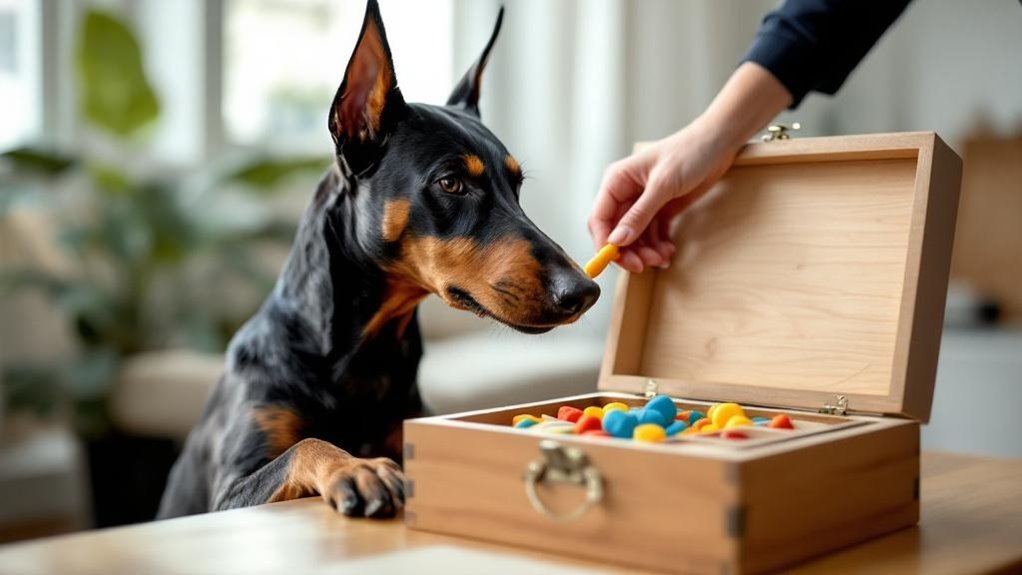
You’ll teach your Doberman to solve puzzles by starting with simple toys, then gradually increasing difficulty as confidence builds. Begin with single-compartment puzzles and food rewards, observing how quickly they solve each challenge to gauge their readiness for complexity. Schedule two to four brief sessions daily, rotating toys and treats to maintain engagement. Watch for frustration signs like excessive barking or head-lowering, which signal you’ve progressed too quickly. Understanding your dog’s problem-solving style reveals how to structure their learning path effectively.
- Key Takeaways
- Why Dobermans Need Mental Challenges Beyond Exercise
- What Puzzle Toys Reveal About Your Doberman’s Brain
- Matching Puzzle Difficulty to Your Doberman’s Current Abilities
- Start Here: The Foundation for Puzzle Success
- High-Value Treats That Drive Puzzle Engagement
- Teach Your Doberman to Interact With Puzzles
- Recognize Frustration Before Your Dog Quits
- The Handler Mistakes That Derail Puzzle Progress
- Move Your Dog From Easy to Hard Puzzles
- When and How to Switch to Harder Challenges
- DIY Doberman Puzzles From Household Items
- Integrate Puzzle Training Into Your Daily Routines
- Scent Work Games Inside Doberman Puzzles
- How Long Should Your Doberman Work on Puzzles?
- Why You Should Watch Your Doberman’s First Puzzle Attempt
- Reward Your Doberman’s Puzzle Problem-Solving
- Indoor Puzzle Techniques When You Can’t Go Outside
- Using Outdoor Environments in Your Doberman’s Puzzle Training
- How Consistent Puzzle Training Prevents Destructive Habits
- Pair Puzzle Training With Physical Exercise
- Diagnose Why Your Doberman Stops Engaging
- Track Your Doberman’s Puzzle Mastery Over Time
- Rotate Puzzles to Keep Interest Fresh
- Frequently Asked Questions
- Conclusion
Key Takeaways
- Start with simple, single-compartment puzzle toys to build confidence before progressing to multi-step puzzles.
- Monitor problem-solving speed and adjust difficulty when your Doberman shows sustained focus and enthusiastic engagement.
- Use immediate high-value rewards and verbal praise to reinforce successful puzzle-solving and maintain motivation.
- Schedule two to four puzzle sessions daily for 10-15 minutes during meals or between play periods.
- Watch for frustration signs like whining, excessive barking, or turning away, then adjust difficulty accordingly.
Why Dobermans Need Mental Challenges Beyond Exercise
While physical exercise is essential for a Doberman’s health, mental challenges play an equally important role in maintaining their overall well-being. Your Doberman’s intelligence demands consistent mental stimulation to prevent boredom, which can trigger destructive behaviors like excessive chewing and barking.
Without adequate cognitive engagement, your dog may develop anxiety and frustration that physical activity alone can’t resolve. Mental stimulation encourages your Doberman to use their natural problem-solving abilities in productive ways.
Activities such as puzzle toys, scent games, and advanced training sessions provide the structure and reliability your dog needs to feel secure and purposeful. By integrating cognitive challenges into daily routines, you give your Doberman the mental outlet necessary for balanced behavior and lasting contentment.
What Puzzle Toys Reveal About Your Doberman’s Brain
Puzzle toys aren’t simply entertainment—they’re windows into how your Doberman thinks and learns. When you observe your dog engaging with puzzle toys, you’ll discover critical information about their cognitive abilities and behavioral patterns.
| Observation | What It Reveals |
|---|---|
| Speed of problem-solving | Learning capacity and intelligence level |
| Puzzle type preference | Natural instincts and motivation drivers |
| Persistence during challenges | Patience and determination traits |
Your Doberman’s approach to puzzle toys demonstrates their problem-solving abilities and mental engagement preferences. You’ll notice how quickly they master new challenges, often requiring just a few repetitions to understand mechanics. Their interest level indicates what stimulates them most effectively, guiding your training strategies. By watching their patience and persistence, you’ll understand behavioral traits that inform future instruction. Puzzle toys fundamentally reveal the breadth of your Doberman’s cognitive capabilities, showcasing their scent detection and manipulation skills in action.
Matching Puzzle Difficulty to Your Doberman’s Current Abilities
Now that you understand what your Doberman’s behavior reveals about their cognitive style, you’ll need to match the puzzle’s difficulty level to where they actually stand right now.
Start with puzzle toys featuring adjustable settings that allow you to control complexity, building your dog’s confidence through early success before advancing to harder challenges.
Observe whether your Doberman solves puzzles quickly or hesitates, then calibrate accordingly. If they disengage or show frustration, you’ve increased difficulty too fast. If they lose interest entirely, the puzzle’s become too simple.
Consistency matters here—rotate between different puzzle toys regularly while maintaining difficulty alignment with their current abilities. This balance keeps their cognitive engagement active without triggering anxiety or boredom.
Start Here: The Foundation for Puzzle Success
Setting up your Doberman for puzzle success requires you to establish a solid foundation before introducing complex challenges, and this foundation rests on three key elements: appropriate toy selection, clear communication about how puzzles work, and reliable reward systems that keep your dog motivated.
Begin your training with simple, adjustable food puzzles that build confidence gradually. Provide hands-on guidance by removing barriers initially, so your Doberman understands the mechanics of accessing treats.
Start with simple, adjustable puzzles that build confidence gradually through hands-on guidance and accessible treat mechanics.
Use high-value, soft, and smelly rewards consistently to reinforce positive behavior and maintain engagement. This consistent structure creates clarity for your dog, establishing the cause-and-effect relationship between effort and reward.
When you rotate puzzle toys and treat options regularly, you prevent boredom while maintaining mental stimulation throughout their training journey.
High-Value Treats That Drive Puzzle Engagement
You’ll want to focus on protein-rich options like cooked hot dogs, meat sticks, or homemade dehydrated liver and chicken treats, as these high-value rewards create strong motivation for your Doberman to engage with puzzle toys.
Rotating between different treats—such as moving from premium proteins to simpler options like Cheerios or veggie bits—maintains your dog’s interest over time and prevents the novelty from wearing off.
This approach to treat selection combines reliability with variety, ensuring that your dog remains consistently motivated while you gradually introduce more challenging puzzle structures.
Selecting Protein-Rich Options
Because a Doberman’s drive to work depends largely on the value it places on the reward, choosing high-protein treats becomes one of your most effective levers for maintaining engagement with puzzle toys.
Protein-rich options like freeze-dried liver and chicken command your dog’s attention while promoting sustained focus during problem-solving sessions. These treats appeal to your Doberman’s natural hunting instincts and nutritional preferences, creating reliable motivation across multiple puzzle attempts.
You’ll notice your dog works more persistently when you offer these premium options compared to standard kibble-based rewards. The concentrated nutrition in protein-heavy treats also supports your dog’s energy levels, enabling longer training sessions without fatigue interfering with learning and engagement.
Rotating Treats For Interest
While your Doberman’s initial enthusiasm for puzzle toys depends on the quality of rewards you offer, maintaining that engagement over time requires strategic variety in the treats themselves. Rotating high-value treats prevents habituation and keeps your dog motivated to solve increasingly difficult challenges.
You’ll find that alternating between different reward types sustains interest far more effectively than relying on a single option.
Consider incorporating these rotating treats:
- Soft, chewy meat sticks
- Homemade dehydrated liver
- Cooked hot dogs
- Cheerios
- Differently flavored training treats
Match treat difficulty to puzzle complexity; simpler puzzles warrant less desirable rewards, while advanced challenges deserve premium options.
Regularly assess and vary your treat selections, ensuring novelty stimulates problem-solving instincts while maintaining consistency with your dog’s overall diet and daily caloric limits.
Teach Your Doberman to Interact With Puzzles
Introducing your Doberman to puzzle toys requires a structured approach that builds confidence and maintains engagement throughout the learning process. Begin with simpler designs that your dog can understand quickly, allowing them to experience success before attempting mentally stimulating advanced puzzles.
Supervise your Doberman’s initial interactions closely, offering guidance and encouragement to minimize frustration. Use high-value treats like soft, chewy snacks or homemade meat options to motivate engagement and sustain their interest in the toy.
Close supervision with guidance and high-value treats minimizes frustration while sustaining your Doberman’s puzzle toy engagement.
Reinforce positive behavior with praise or clicker training, strengthening your bond while developing their problem-solving abilities.
As your Doberman becomes comfortable, gradually introduce more challenging puzzles and rotate options regularly. This consistent progression prevents boredom, maintains their enthusiasm, and guarantees steady skill development over time.
Recognize Frustration Before Your Dog Quits
As your Doberman engages with puzzle toys, you’ll notice that frustration often signals the boundary between productive challenge and overwhelming difficulty. Recognizing these early warning signs allows you to intervene before your dog loses motivation entirely.
Watch for these behavioral indicators:
- Whining or excessive barking directed at the puzzle
- Turning away from the toy or refusing to engage
- Lowering their head while approaching the puzzle
- Pacing in circles around the challenge
- Pawing frantically without strategic problem-solving
When you observe these signs, offer encouragement and gentle guidance through the frustration. This support builds resilience and confidence in your Doberman’s abilities.
If frustration persists despite your assistance, simplify the puzzle temporarily to restore their engagement. Gradually increase complexity while monitoring their reactions, ensuring each session remains positive and stimulating rather than discouraging.
The Handler Mistakes That Derail Puzzle Progress
Even with the best intentions, handlers often make critical mistakes that undermine their Doberman’s progress in puzzle-solving. These errors typically stem from either too much intervention or too little attention to the dog’s actual needs.
You might introduce puzzles that are too complex, overwhelming your dog and causing disengagement, or you might fail to provide adequate rewards, diminishing motivation entirely. Inconsistent challenges without clear guidance confuse your dog’s learning process, while neglecting to supervise during initial use risks frustration and potential choking hazards.
Perhaps most critically, you overlook your dog’s physical state and stress levels, creating negative associations that derail progress. These handler mistakes demand your awareness; maintaining consistency, appropriate difficulty progression, reliable reinforcement, and careful monitoring guarantees your Doberman remains engaged and confident throughout puzzle training.
Move Your Dog From Easy to Hard Puzzles
The foundation of successful puzzle training rests on a carefully structured progression that matches your Doberman’s growing capabilities.
You’ll establish reliability by introducing straightforward puzzle toys first, then systematically increase difficulty as your dog demonstrates mastery.
Start with simple puzzle toys, then gradually increase difficulty as your Doberman masters each level.
Progress through these stages:
- Start with single-compartment puzzle toys requiring minimal manipulation
- Gradually add hidden treats under removable covers or flaps
- Introduce multi-step puzzle toys with adjustable complexity settings
- Present level-based systems that offer escalating challenges
- Combine different puzzle types to maintain engagement
Monitor your Doberman’s patience and motivation throughout each change.
You’ll notice when frustration appears, signaling you’ve advanced too quickly.
Slow your pace, reinforce earlier successes, and allow your dog to build confidence before attempting harder challenges.
This measured approach prevents setbacks while strengthening problem-solving skills consistently.
When and How to Switch to Harder Challenges
Once your Doberman has solved the same puzzle multiple times with consistent success, you’ll want to introduce a harder challenge to sustain their mental engagement and continued cognitive development. Timing matters greatly; advance when your dog completes tasks confidently and quickly, not when they’re still struggling.
Watch for signs of readiness, including sustained focus and enthusiastic participation.
When moving to harder puzzles, increase difficulty incrementally rather than dramatically. A puzzle with more steps, smaller compartments, or requiring different problem-solving strategies works well.
Introduce one new challenge every few weeks to prevent boredom while maintaining mental work that builds their skills.
Monitor your Doberman’s response closely. If frustration emerges through disinterest or stress signals, simplify the task temporarily.
This patience guarantees they develop reliability and confidence in tackling increasingly complex challenges.
DIY Doberman Puzzles From Household Items
You can create effective puzzles from common household items by folding treats inside towels, which encourages your Doberman to use their nose and paws to unwrap the reward.
Alternatively, you can cut holes in cardboard boxes and place treats inside, which challenges them to problem-solve their way to the prize.
These DIY puzzles offer reliable structure and consistency because you control the difficulty level, the treat placement, and the time it takes your dog to succeed, making them practical tools for building confidence as your Doberman develops new skills.
Starting with simpler versions—such as loosely folding a towel or making larger holes in cardboard—allows you to establish your dog’s understanding of the task before you increase the challenge.
Towel And Treat Wrapping
One of the simplest yet most effective puzzle toys you can create involves nothing more than an old towel and some treats your Doberman already enjoys. This activity addresses your dog’s mental stimulation needs while utilizing materials you likely have at home.
To construct this puzzle, follow these steps:
- Hide soft, smelly treats within the towel’s folds
- Use your dog’s nose and paws to search
- Layer treats in various folds for complexity
- Supervise initial attempts to prevent fabric ingestion
- Rotate with other toys to maintain engagement
Choose treats with strong scents that’ll entice your Doberman to investigate thoroughly.
You can increase difficulty by using multiple towels or creating deeper hiding spots.
Supervising your dog during early attempts guarantees safety while building reliability and consistency in their problem-solving behavior.
Cardboard Box Treasure Hunts
Cardboard boxes offer an accessible and effective foundation for creating puzzle toys that’ll challenge your Doberman’s problem-solving abilities while utilizing materials already present in most households.
A cardboard box treasure hunt engages their natural curiosity by hiding treats or favorite toys inside boxes with cut holes. You can increase difficulty by nesting boxes within each other at varying levels, creating progressive challenges that maintain engagement over time.
Adding shredded paper or crumpled fabric to the bottom encourages digging and searching behavior, deepening the puzzle experience.
Monitor your Doberman throughout to prevent cardboard ingestion or contact with non-edible materials.
Regularly rotate treat placement and box arrangements to sustain interest and prevent habituation, ensuring the activity remains stimulating and rewarding.
Integrate Puzzle Training Into Your Daily Routines
How can puzzle training become a reliable part of your Doberman’s day rather than an occasional activity? You establish consistency by weaving puzzle training into existing routines, transforming sporadic sessions into structured daily practice. This approach builds reliability while meeting your dog’s cognitive needs systematically.
Integrate puzzle training through these daily opportunities:
- Short morning sessions using puzzle toys during breakfast to stimulate mental engagement before physical activity
- Post-exercise puzzle sessions that redirect energy and promote relaxation after vigorous play
- Obedience-linked access where your Doberman earns puzzle toys by completing commands
- Evening wind-down routines featuring puzzle engagement to facilitate calm settling before sleep
- Scent-based puzzles hidden throughout your home, tapping natural instincts and maintaining fresh challenges
Rotating toy types prevents habituation while maintaining novelty. This structured integration transforms puzzle training from occasional enrichment into foundational practice, strengthening both cognitive development and behavioral consistency throughout your Doberman’s day.
Scent Work Games Inside Doberman Puzzles
Scent work games represent a natural extension of your daily puzzle routines, building on the consistency you’ve established while capitalizing on your Doberman’s instinctive abilities. These games engage their powerful sense of smell, which drives problem-solving and mental engagement far more effectively than visual puzzles alone.
Scent work games take multiple forms that you can integrate seamlessly into your training schedule. Snuffle mats encourage foraging behavior as your dog uses their nose to locate hidden treats among fabric layers. Indoor treasure hunts scattered throughout your home combine cognitive challenge with physical activity. The cup game structures this process further, requiring your Doberman to select the correct cup hiding a reward.
Gradually increasing difficulty prevents habituation and maintains engagement. Start simple, then progress to more complex hiding locations and subtle scent placements as your dog’s skills develop.
How Long Should Your Doberman Work on Puzzles?
You’ll want to keep your Doberman’s puzzle sessions to 10 to 15 minutes at a time, maintaining consistency with daily engagement while rotating different toys every few days to sustain their interest and prevent mental fatigue.
Watch for signs that your dog’s losing focus or becoming frustrated—yawning, walking away, or repetitive unsuccessful attempts—since these signals indicate you should end the session on a positive note rather than pushing them further.
Building this structure of brief, frequent sessions creates the reliability your Doberman needs to develop strong problem-solving skills without overwhelming their cognitive capacity.
Session Duration And Frequency
Structuring your Doberman’s puzzle-solving sessions with consistent timing and appropriate duration creates the mental framework they need to develop problem-solving skills without becoming frustrated or disengaged.
You’ll find that session duration and frequency work together to maximize engagement and cognitive development.
Optimal session parameters include:
- Five to fifteen minutes per session to maintain focus and prevent frustration
- Two to four sessions daily for sustained mental stimulation
- Consistent scheduling during meals or between play periods
- Observation of your dog’s interest level as a guide for adjustments
- Gradual complexity increases that match your dog’s developing abilities
Monitor your Doberman’s responses carefully, shortening sessions when you notice declining interest or signs of frustration.
This approach guarantees your dog remains engaged while building reliable problem-solving habits through predictable, manageable challenges.
Recognizing Mental Fatigue Signs
How can you tell when your Doberman’s mental work has shifted from productive engagement to fatigue, and what does that fatigue actually look like?
Watch for specific behavioral changes that indicate mental fatigue. Around 15-30 minutes of focused puzzle work, you’ll notice yawning, excessive licking, or a sudden loss of interest in the challenge.
Your dog’s body language shifts noticeably; they may lay down near the puzzle or move away entirely. These aren’t signs of laziness but genuine mental depletion.
Monitor their focus closely during sessions, recognizing that a sharp drop in enthusiasm signals they’ve reached their limit.
When you observe these patterns consistently, you’ll understand your individual dog’s mental capacity, allowing you to structure sessions appropriately and maintain long-term engagement with puzzles.
Why You Should Watch Your Doberman’s First Puzzle Attempt
Observing your Doberman’s first puzzle attempt provides essential information about their problem-solving capabilities and how they respond to new cognitive challenges.
Monitoring their behavior during this initial interaction reveals critical insights that shape your training approach:
Monitoring your Doberman’s initial puzzle behavior reveals critical insights that directly shape your training approach and long-term success.
- Initial reactions showing curiosity versus hesitation
- Speed and effectiveness of their engagement with the puzzle mechanism
- Signs of frustration or confidence as they work through solutions
- Physical responses like ear position and body tension
- Problem-solving strategies they naturally develop
You’ll identify whether the puzzle matches their current skill level or requires adjustment.
Early observation also prevents negative associations by allowing you to intervene if frustration builds.
This foundation establishes reliability in your dog’s approach to cognitive tasks, supporting their willingness to tackle increasingly complex challenges with consistency and confidence.
Reward Your Doberman’s Puzzle Problem-Solving
Positive reinforcement builds the foundation for your Doberman’s puzzle-solving success, so you’ll want to reward them immediately after they solve a puzzle, reinforcing the behaviors that led to their achievement. This immediate feedback creates a clear connection between problem-solving and positive outcomes, strengthening your dog’s motivation to engage with puzzles consistently.
Varying your praise and reward approach maintains your Doberman’s interest over time. Alternate between high-value treats like meat-based snacks and verbal praise to prevent habituation and keep puzzle sessions engaging.
As your Doberman improves, gradually increase puzzle difficulty while maintaining consistent rewards. This structured approach guarantees they associate problem-solving with reliability and success, building confidence that translates into improved cognitive performance and sustained enthusiasm for mental challenges.
Indoor Puzzle Techniques When You Can’t Go Outside
When bad weather or scheduling conflicts keep you indoors, you’ll find that puzzle-solving activities remain just as valuable for your Doberman’s mental development. You can create engaging challenges using items already in your home, establishing structure and consistency that your dog relies on for mental stimulation.
Try these indoor techniques:
- Hide kibble throughout towels and cardboard boxes to activate natural foraging instincts.
- Play the Cup Game by placing treats under one of three cups for discovery.
- Use treat-dispensing puzzle toys that encourage problem-solving engagement.
- Rotate interactive toys regularly to prevent boredom and maintain interest.
- Combine short training sessions with puzzle activities to reinforce obedience.
These methods provide reliability during times when outdoor activities aren’t possible, ensuring your Doberman’s cognitive skills continue developing consistently indoors.
Using Outdoor Environments in Your Doberman’s Puzzle Training
You’ll find that outdoor environments offer your Doberman distinct advantages for puzzle training, as natural elements like grass, leaves, and varied terrain create authentic scent-tracking challenges that strengthen their problem-solving abilities.
By designing park obstacle courses or establishing exploration routes through different settings, you can present environmental puzzles that require your dog to navigate multiple surfaces and distractions while locating hidden rewards.
This combination of mental engagement and physical activity builds both cognitive skills and physical conditioning, which your Doberman needs to maintain peak health and focus.
Natural Scent Tracking Challenges
Three key elements make outdoor scent tracking an effective puzzle-training method for your Doberman: the environment itself, the challenge structure, and your dog’s natural instincts working together.
You’ll tap into their natural prey drive by creating scent trails and hiding rewards throughout outdoor spaces. Here’s how you can structure these challenges:
- Drag favorite toys along the ground to establish scent paths
- Hide treats in grass, woods, or sandy areas for discovery
- Vary terrain types to increase difficulty progressively
- Supervise sessions to maintain focus and prevent frustration
- Rotate locations and items regularly to prevent boredom
Your Doberman’s keen sense of smell becomes the foundation for problem-solving.
Park Obstacle Course Design
Because your Doberman’s problem-solving abilities improve through physical challenges that engage both body and mind, designing an obstacle course in your local park creates an ideal training environment.
You’ll use natural features—benches, logs, and varied terrain—to build a course that addresses your Doberman’s need for mental and physical stimulation simultaneously.
Incorporate different heights and surfaces throughout the course to develop coordination and confidence. Position treats at each station to reinforce positive associations with problem-solving.
Include interactive elements like jumping over logs or weaving between trees, which foster engagement while building strength across different muscle groups.
Rotate course elements regularly to maintain interest and prevent boredom. This structure, consistency, and reliability keep your Doberman mentally sharp while channeling energy productively, reducing destructive behaviors that emerge from understimulation.
Environmental Puzzle Exploration Routes
While park obstacle courses build foundational problem-solving through structured physical challenges, environmental puzzle exploration routes extend that training into the dynamic, unpredictable settings your Doberman encounters during everyday walks. You’ll combine physical exercise with mental stimulation by varying your routes and incorporating puzzle elements into natural surroundings.
Establish diverse exploration routes that challenge your Doberman’s cognitive abilities:
- Hide puzzle toys or treats among trees and bushes along familiar paths
- Use natural obstacles like benches to create visual problem-solving opportunities
- Place scent-detecting objects in varied outdoor locations for nose work practice
- Organize scavenger hunts requiring your Doberman to locate specific items
- Rotate walking routes regularly to expose your dog to novel environmental stimuli
This approach reinforces your Doberman’s ability to solve problems while maintaining consistent physical conditioning and mental engagement across different outdoor environments.
How Consistent Puzzle Training Prevents Destructive Habits
Consistent puzzle training serves as a reliable foundation for preventing destructive behaviors in Dobermans, since these intelligent dogs require substantial mental engagement to remain balanced and content.
When you establish regular puzzle training sessions, you channel your dog’s mental energy constructively, reducing the likelihood of chewing, excessive barking, and anxiety-related destruction. Puzzle training creates structured opportunities for your Doberman to solve problems and expend cognitive effort, which directly counteracts the frustration and boredom that typically trigger unwanted behaviors.
Pair Puzzle Training With Physical Exercise
Pairing puzzle training with physical exercise creates a balanced approach to meeting your Doberman’s dual needs for mental and physical stimulation, since these intelligent dogs thrive when both demands are addressed in a structured way.
This combination reduces frustration and enhances your dog’s ability to concentrate on problem-solving tasks.
You’ll find that sequencing these activities strategically produces exceptional results:
- A brisk walk followed by puzzle training improves focus and calm engagement
- Fetch or tug-of-war sessions before short puzzle games maintain motivation and excitement
- Interactive puzzle toys during cooldown periods reinforce learning while promoting relaxation
- Structured schedules that alternate exercise and puzzle training prevent boredom and destructive habits
- High-energy activities paired with mental challenges provide thorough stimulation
This integrated approach guarantees your Doberman remains engaged, satisfied, and behaviorally balanced throughout the day.
Diagnose Why Your Doberman Stops Engaging
When your Doberman stops engaging with puzzles, you’re likely observing either boredom from repetitive challenges or mental fatigue from sessions that stretch too long. Both of these signal the need for rotation, variety, or shorter time intervals.
Your own emotional state greatly influences your dog’s motivation, as Dobermans are sensitive to handler tension or frustration. This means you’ll need to maintain a calm, positive demeanor to keep your dog invested in the activity.
Boredom and Puzzle Fatigue
The challenge of maintaining your Doberman’s interest in puzzle toys requires understanding that their exceptional intelligence creates a paradox: the faster they solve puzzles, the quicker they’ll abandon them if you don’t evolve the experience.
Boredom develops when puzzles become predictable, and your dog loses motivation to engage.
Combat puzzle fatigue by implementing these strategies:
- Rotate toys every week to prevent familiarity
- Gradually increase difficulty levels based on mastery
- Mix different puzzle types to stimulate varied problem-solving
- Track engagement patterns to identify when interest wanes
- Introduce novel games alongside existing puzzles
Your Doberman needs consistent challenge progression.
Without variety and escalating complexity, even intelligent dogs disengage from repetitive tasks.
Monitor for signs of abandonment or destructive behavior, which signal that your current puzzle structure no longer matches their cognitive capabilities.
Adjust accordingly to maintain their problem-solving enthusiasm.
Handler Emotional State Impact
Your emotional state directly influences your Doberman’s willingness to engage with puzzle toys, since these dogs possess an exceptional sensitivity to their handler’s moods and behavioral cues. When you display frustration or distraction during puzzle sessions, your Doberman’s engagement diminishes greatly.
Conversely, maintaining a calm and confident demeanor fosters security and encourages active problem-solving. The handler emotional state impact extends to consistency; unpredictable moods create anxiety that hinders participation. Dobermans are highly sensitive to emotional fluctuations, making reliable, steady responses essential.
Intimidation or negative reinforcement damages trust and decreases motivation entirely. By sustaining emotional composure and offering positive reinforcement, you establish the structured environment your Doberman needs. This consistency strengthens your bond while promoting sustained engagement with puzzle activities.
Track Your Doberman’s Puzzle Mastery Over Time
Tracking your Doberman’s puzzle-solving progress creates a reliable structure for monitoring improvement, identifying learning patterns, and making informed decisions about training advancement.
You’ll document each training session systematically, recording time taken, engagement levels, and difficulty mastered. This approach reveals your dog’s problem-solving preferences and capabilities over time.
Maintain detailed records by noting:
- Puzzle type completed and date mastered
- Time required to solve each challenge
- Engagement level during training sessions
- Problem-solving methods your Doberman prefers
- Progression from easier to harder difficulty levels
Regular updates after each training session enable you to adjust puzzle difficulty appropriately, ensuring consistent mental stimulation without frustration or boredom.
You’ll recognize when your Doberman’s ready for advancement, preventing plateaus in learning while supporting sustained cognitive development.
Rotate Puzzles to Keep Interest Fresh
You’ll maintain your Doberman’s mental engagement by rotating puzzles weekly, introducing new challenges that prevent the boredom that leads to destructive behaviors.
Establishing a structured rotation schedule—alternating between treat-dispensing balls, level-based boards, and scent-enriched Kongs—keeps their problem-solving skills sharp while building consistency and reliability into their training routine.
This strategic variety guarantees your dog remains cognitively stimulated, as each puzzle type targets different skills and sustains their natural curiosity across sessions.
Variety Maintains Mental Engagement
Because Dobermans are intelligent and quick learners, they’ll lose interest in puzzles that remain static or repetitive, making variety essential to sustaining their mental engagement over time.
You’ll maintain their focus by introducing different puzzle types that challenge them in new ways:
- Treat-dispensing balls that require rolling and manipulation
- Interactive boards with sliding compartments and hidden sections
- DIY options like treats hidden in rolled towels
- Cardboard boxes with compartments to tear and explore
- Puzzle boxes with rotating or removable pieces
Rotating these options prevents habituation, ensuring your Doberman remains engaged and motivated.
Fresh experiences directly combat the disengagement that occurs when puzzles become predictable. This consistency in introducing novelty creates the mental stimulation your dog requires for sustained cognitive development and behavioral balance.
Scheduling Rotation Strategies
Establishing a structured rotation schedule forms the foundation of sustained puzzle engagement, transforming what might otherwise become a chaotic collection of toys into a reliable system that keeps your Doberman’s mind active.
You can implement weekly or bi-weekly changes that create predictability and anticipation for your dog, contributing meaningfully to their mental well-being. By monitoring your Doberman’s problem-solving speed with each puzzle toy, you’ll recognize when they’ve mastered a challenge and need something more demanding.
This observation-based approach guarantees you’re rotating at the right intervals rather than guessing. Consistent scheduling works because it establishes routine, allowing your dog to understand expectations while preventing the stagnation that leads to disinterest and destructive behaviors.
Frequently Asked Questions
How to Keep Dobermans Entertained?
You’ll keep your Doberman entertained by rotating puzzle toys, conducting short training sessions, and incorporating scent work games like snuffle mats. Regularly increase difficulty levels and introduce new challenges to maintain their cognitive engagement and prevent boredom.
What Is 15 Minutes of Mental Stimulation for Dogs?
You’re engaging your dog’s mind like you’d operate a Victorian steam engine—fifteen minutes of mental stimulation equals roughly one hour of physical exercise. You’re activating their cognitive abilities, reducing boredom, and preventing destructive behaviors effectively.
What Not to Do With a Doberman?
You shouldn’t use harsh training methods, introduce complex puzzles too quickly, or leave your Doberman unsupervised with puzzle toys initially. Don’t repeat the same activities constantly, and avoid neglecting socialization opportunities during training sessions.
How Difficult Is It to Train a Doberman?
Training your Doberman is smooth sailing because they’re highly intelligent and quick learners who master new tasks in just a few repetitions. You’ll find consistency and positive reinforcement yield impressive results rapidly.
Conclusion
You’ve built a reliable structure for puzzle training that mirrors the telegraph’s revolutionary approach to communication—breaking complex information into manageable signals. Your Doberman’s cognitive development depends on consistency, rotation, and matching difficulty to current abilities. By tracking progress and adjusting engagement strategies, you’ve created a sustainable system that strengthens the bond between you and your dog while providing the mental stimulation they require for behavioral stability and psychological well-being.