Affiliate Disclosure: This post may contain affiliate links. If you purchase through them, DobermanSmarts may earn a small commission at no additional cost to you. We only recommend products, tools, and resources we genuinely believe can help Doberman owners.
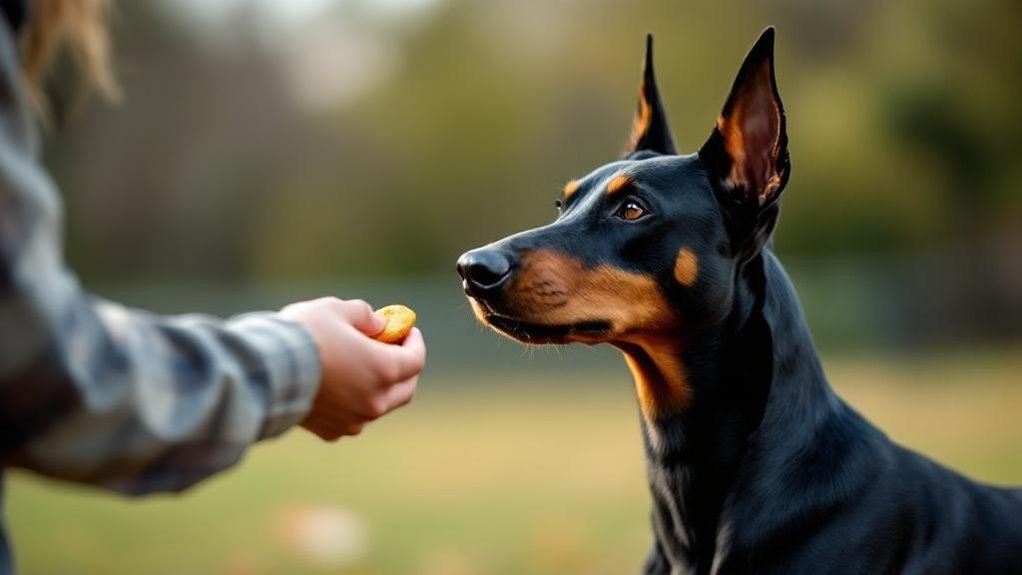
Marker training uses consistent verbal signals like “YES” to mark the exact moment your Doberman performs the desired behavior, creating clarity about what earns rewards. You deliver the marker within half a second of the action, then follow with a high-value treat, establishing a reliable link between behavior and consequence. This approach maintains engagement through structure and consistency, prevents confusion from delayed reinforcement, and works especially well with Dobermans’ natural inclination toward interaction. Success depends on precise timing, identical commands across all family members, and brief, frequent sessions to sustain focus. Understanding how to adjust this system for individual preferences and distractions will markedly strengthen your results.
- Key Takeaways
- Why Engagement Is Everything for Dobermans
- What Marker Training Is and Why It Works
- Your First Training Session: Setting Up for Success
- The Five Marker Words and When to Use Them
- Charging the Mark: Teaching Your Doberman to Listen
- Identifying What Motivates Your Doberman Most
- Food, Toys, or Praise: Which Reward Works Best
- Timing Your Mark: The Difference Between Success and Confusion
- Why the Mark Must Come Before the Reward
- Start With Gestures, Add Words Later
- Luring vs. Commanding: Know the Difference
- Teaching Commands That Work in Any Situation
- Adding Distractions Without Losing the Mark
- Building Impulse Control Through Marker Training
- Breaking Complex Behaviors Into Smaller Steps
- When Your Doberman Has Low Food Drive
- Keep Your Doberman Guessing: Variable Rewards Explained
- The One-Yes Rule and Other Common Mistakes
- Marker Training for Stubborn or Dominant Dobermans
- Fading Rewards While Keeping Behaviors Strong
- When Marker Training Stops Working (And How to Fix It)
- Frequently Asked Questions
- Conclusion
Key Takeaways
- Marker training uses operant conditioning to link Doberman actions to immediate consequences through consistent verbal markers like “YES.”
- Deliver the marker within half a second of desired behavior to establish clear associations and prevent confusion.
- Select quiet environments and use high-value treats to maintain engagement, keeping initial sessions brief at 5-10 minutes.
- Ensure all family members use identical commands and markers for consistency, preventing mixed signals that derail learning.
- Gradually layer distractions into training while maintaining high-value rewards to sustain focus despite environmental pressures.
Why Engagement Is Everything for Dobermans
Engagement is the foundation of successful marker training with Dobermans, and you’ll find that their natural inclination toward interaction with handlers makes this approach particularly effective for the breed.
When you keep your Doberman engaged during training sessions, you harness their intrinsic motivation to focus and respond to commands. An engaged dog connects the marker signal with the reward, strengthening the association between behavior and consequence.
Without this engagement, distractions derail learning, and your Doberman won’t reliably perform commands. You’ll see dramatic improvements when you use high-value rewards and interactive play to maintain their interest.
What Marker Training Is and Why It Works
Since you’ve built engagement with your Doberman, you’re ready to understand the specific mechanics that make marker training so effective for this breed.
Marker training operates through operant conditioning, creating clear associations between your dog’s actions and their consequences. You use positive markers—like the word “YES”—to signal that a reward follows immediately, bridging the gap between behavior and reinforcement. Immediate consequences prove essential because delays confuse dogs about why they’re rewarded, undermining learning clarity.
This approach fosters confidence by replacing corrections with problem-solving opportunities, encouraging your Doberman to experiment and engage actively. The structure and consistency of marker training provide the reliability this intelligent breed needs to understand exactly what earns reward, making learning both efficient and genuinely engaging.
Your First Training Session: Setting Up for Success
Now that you understand how marker training creates clear associations between behavior and reward, you’re ready to design your first session in a way that sets your Doberman up for genuine success. Your environment matters greatly; choose a quiet, distraction-free space where your dog can focus entirely on you and the training command. Gather high-value treats that your Doberman consumes quickly, maintaining training momentum. Keep your first training session brief—five to ten minutes prevents fatigue and sustains engagement. Use consistent verbal markers like “YES” for correct behavior and “NOPE” for mistakes, establishing immediate consequences your dog understands. Guarantee all family members use identical commands and markers, creating the consistency and reliability your Doberman needs to learn effectively.
| Element | Purpose | Duration |
|---|---|---|
| Environment | Minimize distractions | Ongoing |
| Treats | Motivate behavior | Quick consumption |
| Session length | Maintain focus | 5-10 minutes |
| Markers | Create clarity | Immediate feedback |
The Five Marker Words and When to Use Them
You’ll use five distinct marker words to structure your Doberman’s training sessions, each serving a specific function that builds reliability and clarity into your work together.
“Ready” signals the beginning of focused training, “Yes” marks the exact moment your dog performs correctly, “GOOD” extends that positive reinforcement to encourage duration and consistency, “NOPE” indicates a mistake without punishment, and “DONE” cleanly ends the session so your dog knows when training is finished.
Understanding when and how to deploy each word creates the framework that makes marker training effective, transforming random corrections into a language your dog can learn and trust.
Ready: Starting Your Session
The first of your five marker words, “Ready,” serves as the gateway to every training session, signaling to your Doberman that engagement and focus are about to begin.
When you speak this word, you’re establishing a clear psychological cue that prepares your dog mentally for the work ahead. Your Doberman learns to recognize “Ready” as the moment when dog’s attention becomes essential, sharpening their focus on you and anticipated commands.
Consistency matters greatly here—using “Ready” at the identical point in each session reinforces structure and reliability. Say it immediately when you’re prepared to engage, creating a dependable routine your dog understands.
This straightforward training technique transforms “Ready” into a powerful tool that encourages your Doberman to anticipate subsequent commands and rewards.
Yes, Multiple, Nope: Marking Behavior
Once you’ve established focus with “Ready,” the remaining four marker words—”Yes,” “NOPE,” “GOOD,” and “DONE”—create a complete communication system that clarifies exactly which behaviors earn rewards and which don’t.
“Yes” marks the precise moment your Doberman performs correctly, bridging the gap between action and reward so they understand what earned reinforcement.
“GOOD” emphasizes exceptional performance, building enthusiasm for training.
“NOPE” signals mistakes without punishment, prompting your dog to retry the behavior for another chance at success.
This marker system provides structure and consistency, allowing your Doberman to learn quickly through clear feedback.
The reliability of these distinct signals transforms training into a logical dialogue where your dog confidently understands expectations and outcomes.
Done: Ending Training Effectively
Completing your training session with a clear “DONE” marker gives your Doberman permission to shift from focused work to relaxation, creating a definitive boundary between training time and free time.
When you use “DONE” consistently, your dog learns to anticipate the conclusion of work, which sharpens their attention throughout the entire session. This predictability reduces confusion about what you expect, allowing your Doberman to settle calmly as training wraps up.
The marker signals achievement, reinforcing that your dog has successfully completed the tasks for that period. By establishing this structured routine, you’re building reliability into your training approach.
Your Doberman will understand when concentration ends and when they can finally release tension, fostering both mental clarity and behavioral confidence.
Charging the Mark: Teaching Your Doberman to Listen
Building a reliable marker system requires that you first establish a clear, consistent signal your Doberman can recognize and trust.
You’ll use a verbal marker like “YES” to signal that your dog’s performed the desired behavior correctly, creating a bridge between the action and the reward. This dog training method works because your Doberman learns to associate the marker with immediate praise and reward, strengthening the connection to the behavior.
Deliver your marker within half a second of the correct action, ensuring your Doberman understands exactly what earned the reinforcement. Consistency matters greatly; use the same word every time so your dog develops reliability in response.
Once your Doberman reliably responds to the verbal marker, you’ve successfully charged the mark, establishing a foundation for all future training advancement.
Identifying What Motivates Your Doberman Most
You’ll discover what truly motivates your Doberman by conducting a systematic preference assessment, offering various high-value treats like venison steak or soft training bites alongside toys and physical interaction.
Then, observe which rewards generate the strongest response and sustained engagement. Individual preferences vary considerably among dogs, so your careful observation of which motivators produce genuine enthusiasm—rather than mere compliance—will establish the foundation for reliable marker training sessions.
Once you’ve identified your Doberman’s primary motivators through this experimentation, you can structure your training around those specific rewards, ensuring consistency and reliability in your dog’s willingness to participate.
High-Value Treat Selection
Three elements define successful marker training: timing, consistency, and the right reward, with treat selection being the most critical foundation for keeping your Doberman engaged and motivated. You’ll find that soft, meaty options work best during training sessions because they’re quick to consume and maintain focus.
| Treat Type | Consumption Speed | Engagement Level |
|---|---|---|
| Venison steak | Fast | High |
| Bocces Bakery bites | Fast | High |
| Hard kibble | Slow | Low |
Conduct a preference experiment by presenting various high-value treats to identify what motivates your dog most. Adjust treat size based on your environment’s distraction level, using larger pieces in challenging settings. Rotate treats regularly throughout your training sessions to prevent predictability and sustain your Doberman’s interest in working with you.
Individual Preference Assessment
What truly motivates your Doberman isn’t always obvious, so identifying individual preferences requires systematic observation and controlled experimentation rather than assumptions based on breed tendencies.
You’ll discover what your dog needs by presenting different treats while holding the leash, observing which items generate the strongest response. Assess engagement with various toys, noting whether tug ropes or squeaky toys elicit more enthusiasm.
Monitor your Doberman’s energy levels during training certain exercises with specific rewards, as heightened engagement indicates ideal motivators. Track reactions to both physical activities and verbal praise consistently.
This structured approach helps you reward the dog with what genuinely excites them most. Higher motivation translates directly into improved training outcomes and faster skill acquisition, making preference assessment essential for effective marker training success.
Food, Toys, or Praise: Which Reward Works Best
Because Dobermans respond powerfully to different motivational triggers, selecting the right reward system forms the foundation of effective marker training. High-value food treats, such as soft treats or venison steak, leverage your dog’s keen sense of smell and prove particularly effective during initial learning phases.
Praise paired with enthusiastic tone and gestures greatly boosts motivation, since Dobermans are keen to please their handlers. Toys can serve as rewarding substitutes once your dog demonstrates command understanding, providing engagement without food dependency.
The critical factor across all reward types involves timing: deliver your chosen reward within half a second of the desired behavior to reinforce correct associations. Assess your individual Doberman’s preferences, then structure your training around what motivates that specific dog most effectively.
Timing Your Mark: The Difference Between Success and Confusion
The split-second you deliver your marker determines whether your Doberman grasps the connection between action and reward, or becomes confused about what behavior you’re actually reinforcing. Timing the dog’s response within half a second creates clarity, while delays breed uncertainty about which action earned the reward.
| Timing | Result | Dog Understands |
|---|---|---|
| Within 0.5 seconds | Clear association | Yes |
| 1-2 seconds delay | Confused response | No |
| Inconsistent timing | Unreliable learning | Partial |
When you give the command and mark immediately upon correct execution, your Doberman connects the specific behavior to the forthcoming reward. Consistency in this timing structure builds reliability, allowing your dog to predict outcomes and aim for desired actions repeatedly, accelerating overall training progress.
Why the Mark Must Come Before the Reward
Your marker’s position in the sequence—before the reward arrives—determines whether your Doberman truly understands what behavior earned the payoff. When you deliver the marker first, you create a clear structure that your dog can reliably follow.
The marker signals the exact moment your Doberman performed correctly, establishing consistency between action and consequence. This timing matters because it bridges the gap between the behavior and the delayed reward, preventing confusion about which action you’re reinforcing.
Without this precise order, your Doberman struggles to connect the dots. Delivering the reward before marking leaves ambiguity about what earned it, undermining your training’s effectiveness and your dog’s confidence in repeating desired behaviors.
Start With Gestures, Add Words Later
Starting with visual gestures rather than words capitalizes on what Dobermans do naturally—they’re highly attuned to body language and can more readily associate movements with actions before verbal cues become meaningful.
When you start training, use consistent gestures like pointing or specific hand signals for each command, enabling your dog to differentiate between them easily. Once your Doberman reliably responds to these visual cues, gradually introduce verbal commands alongside the gestures.
The consistent use of gestures followed by words reinforces the connection between the demonstrated action and the expected behavior. This layered approach leverages Dobermans’ natural engagement and playfulness, making training sessions more productive while building reliable associations that translate into dependable obedience.
Luring vs. Commanding: Know the Difference
Once your Doberman understands visual gestures and responds reliably to paired verbal cues, you’ll face an important decision about how to solidify these behaviors: using lures or relying on commands alone.
| Aspect | Luring | Commanding |
|---|---|---|
| Method | Guide with treat | Verbal/visual cues only |
| Initial Learning | Fast establishment | Requires foundation |
| Long-term Reliability | Treat dependency risk | Strong consistency |
Luring helps you teach the dog initial positions quickly through immediate rewards, but this approach can create treat reliance. Commanding, however, develops your Doberman’s independent thinking and strengthens your bond. The key distinction: luring prompts action through tangible motivation, while commanding encourages response through established understanding. You’ll shift from luring to commanding gradually, ensuring your dog responds based on recognition rather than visible rewards, building genuine obedience and deeper handler-dog connection.
Teaching Commands That Work in Any Situation
Teaching commands that truly work across different environments requires more than memorizing a single response in your living room; it demands a deliberate structure built on marker training, consistency, and gradual environmental challenges.
You’ll teach your Doberman that commands mean the same thing everywhere by using consistent verbal markers like “YES” and “NOPE” paired with visual cues, which reduces confusion and strengthens reliability.
Start training in familiar spaces, then gradually introduce distractions and new locations. Short, focused sessions maintain your dog’s attention while building generalization skills.
When your Doberman responds reliably to commands indoors, you can come back to outdoor settings with confidence, knowing the foundation supports success across varied situations.
Adding Distractions Without Losing the Mark
Your Doberman’s ability to recognize and respond to the marker signal will strengthen only when you deliberately layer distractions into training sessions, starting small and building gradually to higher-level challenges. This progression develops reliability across different environments and situations.
- Begin with low-level distractions such as background noise or subtle movement, allowing your dog to maintain focus while learning the marker’s value.
- Use your marker immediately when correct behavior occurs, even amidst distractions, reinforcing the connection between command and action.
- Escalate to higher distractions including other dogs or people moving nearby, only after your Doberman demonstrates consistent responsiveness.
- Maintain high-value rewards that sustain focus despite increasing environmental pressure, ensuring your dog remains motivated.
Consistent practice in varied settings allows your Doberman to generalize the marker’s significance and preserve responsiveness under challenging conditions.
Building Impulse Control Through Marker Training
Marker training’s effectiveness extends beyond teaching reliable responses in distracting environments, reaching into the deeper work of building genuine impulse control that allows your Doberman to make deliberate choices rather than react instinctively.
When you use marker training consistently, you’re creating a communication system that helps your dog pause before acting, considering whether a behavior will earn rewards or not. The immediate reinforcement clarifies which actions deserve rewards, strengthening your dog’s ability to regulate their responses.
Short, frequent training sessions of five to ten minutes maintain focus without overwhelming your Doberman’s cognitive capacity. This structured approach develops reliability in impulse control, enabling your dog to demonstrate consistent self-regulation across various situations and environments.
Breaking Complex Behaviors Into Smaller Steps
Complex behaviors that seem overwhelming at first become manageable when you break them down into smaller, learnable steps, allowing your Doberman to progress gradually without frustration or confusion. This structured approach guarantees your dog understands each component before moving forward.
When breaking complex behaviors into smaller steps, you’ll:
- Identify the final behavior you want to teach your dog.
- Divide it into distinct, achievable actions your dog can master quickly.
- Use positive markers like “YES” after each successful step to reinforce progress.
- Gradually increase difficulty once your dog demonstrates reliability at each level.
For example, teaching “drop it” starts with rewarding simple toy release, then progresses to dropping higher-value items.
Consistent implementation builds your dog’s confidence and mastery, making training both effective and rewarding for you both.
When Your Doberman Has Low Food Drive
Not every Doberman responds equally to food-based rewards, and you’ll encounter situations where your dog shows minimal interest in treats despite your best efforts with standard kibble or common training snacks.
When you face low food drive, identify high-value rewards that excite your dog, such as venison steak or specialized training bites. Incorporate play and toy rewards as effective alternatives, since many Dobermans respond with greater enthusiasm to interactive games and favorite toys.
Use shorter training sessions with immediate rewards to keep your dog engaged and prevent boredom. Explore new environments and vary your training routines to stimulate interest, which helps engage the dog and redirect focus toward you instead of distractions.
Pair play activities with positive reinforcement to increase overall drive and responsiveness.
Keep Your Doberman Guessing: Variable Rewards Explained
One of the most effective ways you can maintain your Doberman’s enthusiasm during training is through variable rewards, a technique that delivers treats, praise, or play unpredictably rather than after every successful behavior.
This approach leverages operant conditioning principles, where uncertainty keeps your dog engaged and motivated to perform desired behaviors consistently. You’ll notice your Doberman remains more attentive when they can’t predict exactly what reward comes next.
Uncertainty in rewards keeps your Doberman engaged and motivated to consistently perform desired behaviors during training.
To implement variable rewards effectively:
- Mix high-value treats with occasional praise to maintain interest
- Alternate between treats, toys, and playtime across sessions
- Vary the timing of rewards to prevent predictability
- Combine multiple reward types within single training sequences
The One-Yes Rule and Other Common Mistakes
You’ll find that the One-Yes Rule—using a single, consistent marker rather than multiple variations—creates the clarity your Doberman needs to understand exactly which behavior earns the reward.
Deviating from this structure introduces confusion that undermines your training’s reliability. Timing errors, where you delay your marker even by a few seconds, break the critical link between the behavior and its consequence, causing your dog to lose focus and misidentify what action you’re actually rewarding.
Over-marking or switching between different marker words similarly damages consistency, so you must commit to one marker sound and use it with precision every time your Doberman performs the desired behavior.
Timing Errors In Marker Training
Timing errors in marker training can derail a Doberman’s learning process, making precision the foundation of effective communication between you and your dog. You must deliver your marker signal within half a second of the desired behavior, ensuring your dog connects the action with reinforcement.
Consider these critical timing elements:
- Immediate feedback reinforces correct actions without confusion or delay.
- A consistent timeline between marker and reward prevents uncertainty about which behavior earned praise.
- Delayed markers disrupt your dog’s ability to link behavior with reinforcement, creating inconsistent learning patterns.
- Maintaining reliability in your timing builds trust and accelerates your Doberman’s understanding.
When you fail to maintain this precise window, your dog becomes uncertain about what action actually earned the reward, hampering training progress considerably.
Consistency in your delivery creates clarity.
Over-Marking The Desired Behavior
While precise timing builds the foundation for marker training, how you deliver your markers matters just as much as when you deliver them. Over-marking—using multiple “yes” markers for a single desired behavior—dilutes the significance of your signal and confuses your Doberman about which action earned the reward. The One-Yes Rule establishes clarity: one marker, one reward, one learning moment. When you stay consistent with a single affirmative marker, your dog develops reliable understanding of what behavior to repeat.
| Marking Mistake | Effect on Training |
|---|---|
| Multiple markers per behavior | Diluted signal clarity |
| Inconsistent marker sounds | Confusion about desired behavior |
| Delayed rewards after markers | Weakened behavior association |
| Excessive marking frequency | Overwhelmed learning process |
| Varying marker timing | Inconsistent dog responses |
Your Doberman learns fastest when you maintain discipline in your marking structure, delivering one clear “yes” followed immediately by reward.
Inconsistent Marker Word Usage
Many trainers underestimate how deeply confusion about your marker word can disrupt a Doberman’s learning process, yet this inconsistency ranks among the most common training obstacles.
When you fail to maintain consistent marker usage, your dog struggles to connect specific behaviors with rewards, creating frustration for both of you.
Establish reliability through these practices:
- Use only one marker word across all training sessions
- Deliver the marker with animated, excited intonation consistently
- Reward immediately after marking to prevent behavioral misassociation
- Apply the marker uniformly regardless of location or distractions
Your Doberman depends on this structure for clarity.
Switching between different marker words or inconsistently marking desired behaviors undermines your training foundation, leading to unpredictable learning outcomes and confusion about what you’re actually reinforcing.
Marker Training for Stubborn or Dominant Dobermans
Because stubborn or dominant Dobermans often resist commands and require clearer communication between their actions and rewards, you’ll need to adjust your marker training approach with greater patience and consistency than you might use with more responsive dogs.
Your success depends on establishing reliable associations between the marker word “YES” and immediate rewards, which demands frequent repetition and instant marking each time your Doberman performs correctly. Use high-value treats tailored to your dog’s preferences to increase motivation and engagement throughout training sessions.
Incorporating interactive games as rewards maintains their interest and encourages active participation. You must also cultivate a positive training atmosphere free from harsh corrections, since stubborn Dobermans respond better to encouragement than negative reinforcement, ultimately creating an environment where learning becomes possible.
Fading Rewards While Keeping Behaviors Strong
Once your Doberman has developed reliable command execution through consistent marker training, you’ll need to gradually reduce treat frequency while maintaining the strength of learned behaviors. This process requires strategic planning and careful observation of your dog’s responses.
Fading rewards effectively involves implementing these key strategies:
- Shift from high-value to low-value rewards as proficiency increases, reinforcing learning without creating treat dependency.
- Adopt a variable reward schedule, offering treats randomly rather than predictably, which keeps your dog engaged and focused.
- Continue using verbal markers like “YES” even when food rewards decrease, ensuring your dog understands its actions remain valued.
- Introduce alternative reinforcements such as play or toys alongside fading treats, creating well-rounded motivation.
This structured approach maintains behavioral consistency while reducing reliance on food-based rewards alone.
When Marker Training Stops Working (And How to Fix It)
Even with a well-structured reward schedule in place, you might find that your Doberman’s responsiveness to markers begins to fade, whether through predictable reward patterns, timing inconsistencies, or environmental pressures that pull his attention away from the training framework.
To restore engagement, examine your reinforcement timing first—deliver rewards within half a second of the marker for maximum clarity. If your marker itself lacks distinctiveness, switch to a consistent, positive marker like “YES” to strengthen his understanding.
Deliver rewards within half a second of the marker for maximum clarity, and use a consistent, positive marker like “YES” to strengthen understanding.
Vary your reward types to prevent predictability from dulling his motivation. Additionally, return to low-distraction environments to rebuild focus before gradually introducing complexity.
Regular assessment of his comprehension, combined with adjusted techniques such as visual cues, will revive your marker training effectiveness.
Frequently Asked Questions
What Is the 7 7 7 Rule for Dogs?
You’ll train your dog seven minutes, seven times daily to maintain peak engagement. This approach capitalizes on your dog’s attention span, prevents boredom, reinforces learning, and helps you generalize commands across various contexts effectively.
What Are the Best Markings for Dobermans?
You’ll hit the jackpot using “YES” as your primary marker for Dobermans—it’s enthusiastic and rewards-focused. Pair it with “NOPE” for mistakes, “GOOD” for duration, and “DONE” when finishing sessions. You’ve got your training toolkit.
What Is the 3-3-3 Rule for Dog Training?
You’ll find that the 3-3-3 Rule breaks down your dog’s adjustment into three phases: three days for initial anxiety, three weeks for personality emergence, and three months for full acclimation and behavioral stability.
Why Do Police Not Use Dobermans Anymore?
You’ll find that police departments have shifted away from Dobermans because they’re independently minded and harder to train than Belgian Malinois—a breed now preferred in roughly 90% of modern K-9 units for their reliability.
Conclusion
You’ve built a foundation with marker training, creating a bridge between your commands and your Doberman’s responses. Like a lighthouse guiding ships through fog, your consistent marks illuminate the path your dog should follow. You’ll find that reliability grows through repetition, structure deepens through patience, and your relationship strengthens through clarity. Continue refining these tools, and you’ll discover that marker training isn’t merely technique—it’s the language you and your Doberman now share.