Affiliate Disclosure: This post may contain affiliate links. If you purchase through them, DobermanSmarts may earn a small commission at no additional cost to you. We only recommend products, tools, and resources we genuinely believe can help Doberman owners.
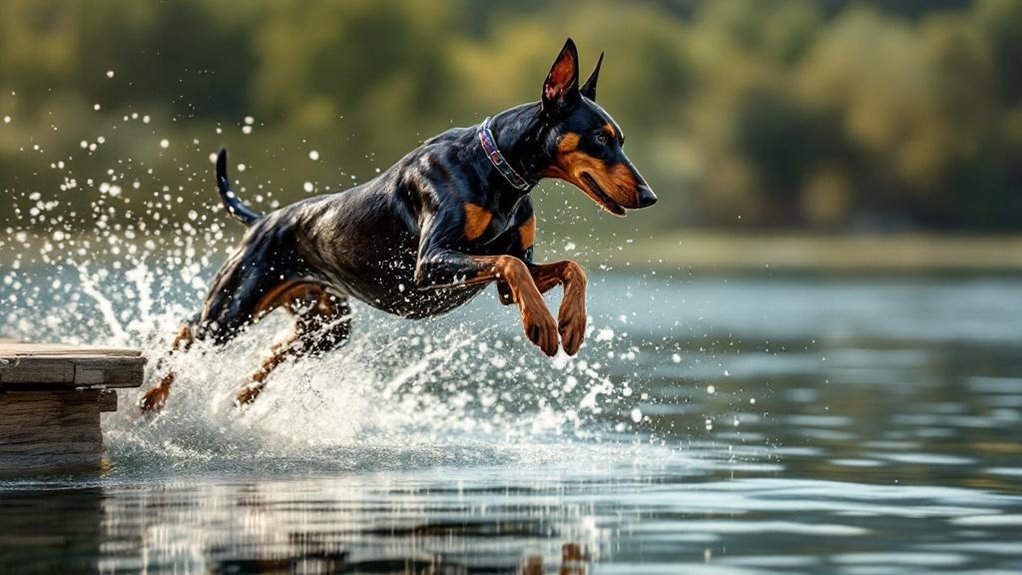
You can train your Doberman for dock diving by leveraging their natural athleticism, muscular structure, and swimming ability. Start by evaluating water comfort through gradual exposure in shallow environments, then systematically build explosive power and endurance through swimming, running, and fetch games. Establish foundational obedience, maintain consistent conditioning with proper nutrition and hydration, and practice on docks to acclimate your dog to competition conditions. Understanding the specific mistakes that derail progress will strengthen your approach.
- Key Takeaways
- What Is Dock Diving and Why Dobermans Excel at It
- Why Doberman Athleticism Dominates Dock Diving
- Is Your Doberman Ready to Start?
- Does Your Doberman Actually Like Water?
- Essential Nutrition for Peak Performance
- Training Equipment You’ll Need Before Day One
- Dock Diving Step 1: Build Water Confidence
- Dock Diving Step 2: Teach the Jump
- Dock Diving Step 3: Drive Retrieval Instinct
- Dock Diving Step 4: Extend Distance and Flight
- Dock Diving Step 5: Build Strength and Stamina
- How to Structure Your Training Year
- What Makes Dock Diving Competitions Different?
- Big Air vs. Extreme Vertical: Which Fits Your Doberman?
- Speed Retrieve and Dueling Dogs Explained
- Competition Rules Every Handler Must Know
- How to Find Dock Diving Events in Your Area
- Four Dock Diving Mistakes That Derail Progress
- Keeping Your Doberman Healthy Between Training Sessions
- Competition Day: What to Expect and How to Prepare
- Frequently Asked Questions
- Conclusion
Key Takeaways
- Dobermans excel at dock diving due to their natural athleticism, muscular structure, and strong swimming ability, making them ideal competitors.
- Start training at minimum six months of age with gradual water exposure, positive reinforcement, and foundational obedience skills.
- Build explosive power through systematic conditioning combining swimming, running, resistance training, and varied terrain to develop specific muscle groups.
- Practice retrieval instincts using high-value toys at increasing distances in controlled environments before advancing to competition dock settings.
- Find dock diving events through the official DockDogs® website, local training facilities, and community programs; handlers must be at least seven years old.
What Is Dock Diving and Why Dobermans Excel at It
Dock diving, a competitive dog sport that’s gained popularity over the past two decades, involves launching off a dock into water to retrieve a toy.
It’s a pursuit where Dobermans consistently demonstrate exceptional capability. You’ll find that Dobermans excel in dock diving because they possess the athleticism, swimming ability, and retrieving drive that the sport demands.
Dobermans excel in dock diving through their athleticism, swimming ability, and natural retrieving drive that the sport demands.
Their natural musculature and high energy levels position them as strong competitors in jumping-distance events like Big Air and Extreme Vertical competitions.
When you consider a Doberman’s inherent physical structure and reliability in water, you recognize why they’re well-suited for dock diving.
The sport aligns with their instinctive behaviors, making it an ideal competitive outlet that harnesses their strengths effectively.
Why Doberman Athleticism Dominates Dock Diving
Athletic excellence in Dobermans stems from their muscular structure, explosive power, and refined coordination, qualities that translate directly into superior dock diving performance.
You’ll find that Doberman Pinschers possess the physical attributes necessary to generate impressive jump distances, combining strength with agility in ways few other breeds can match.
Their endurance proves equally important, allowing you to push them through multiple attempts without compromising performance.
When you condition a Doberman consistently, you’re building not just muscle but also cardiovascular reliability that sustains competitive efforts.
The breed’s natural retrieving instincts amplify their motivation, driving them to pursue maximum distances with genuine enthusiasm rather than reluctant compliance.
This combination of structural advantage and psychological drive creates competitors who dominate dock diving events through genuine physical capability and consistent performance.
Is Your Doberman Ready to Start?
Before you commit your Doberman to dock diving training, you’ll need to confirm that your dog possesses both the physical foundation and psychological readiness for this demanding sport. Start by evaluating your dog’s age, fitness level, and comfort in water, as these factors determine success in dog sports like dock diving.
Readiness Assessment:
- Your Doberman should be at least six months old with demonstrated muscle strength and cardiovascular endurance.
- Your dog must show genuine comfort and confidence around water, beginning in shallow areas with positive reinforcement.
- Basic command responsiveness and obedience provide the structure necessary for reliable training progression.
Conduct a formal fitness evaluation to measure your dog’s capabilities.
Monitor hydration and nutrition throughout preparation.
This deliberate approach guarantees your Doberman develops the consistency and reliability required for competitive dock diving.
Does Your Doberman Actually Like Water?
How can you determine whether your Doberman genuinely enjoys water, or simply tolerates it? You’ll want to observe your dog’s behavior during playtime near water, noting whether they wholeheartedly chase objects or splash with obvious joy.
Many dogs display hesitation initially due to their cautious nature, so gradual exposure with positive reinforcement helps build comfort.
Pay attention to your Doberman’s prey drive, which often translates into enthusiastic retrieval of toys thrown into water.
Early socialization matters considerably; puppies introduced to water in positive environments typically become adults who enjoy it.
Watch for consistent patterns rather than isolated reactions. Your dog’s individual preferences can vary widely, so patience and observation reveal their true relationship with water before you begin dock diving training.
Essential Nutrition for Peak Performance
You’ll need to provide your Doberman with a diet that delivers adequate protein and fat to support the intense physical demands of dock diving training, as these nutrients fuel muscle performance and enable quick recovery between sessions.
Ingredients like glucosamine and chondroitin protect your dog’s joints during high-impact jumps, while antioxidants sharpen focus and responsiveness when you’re working through challenging exercises.
Consistent access to fresh water before and after training, combined with balanced nutrition, establishes the foundation your Doberman needs to perform reliably and stay healthy throughout the sport.
Nutrient Requirements For Performance
When your Doberman’s muscles are firing at full intensity during dock diving training and competition, the nutritional foundation you’ve built becomes the difference between sustained peak performance and early fatigue. Your dog’s nutrient requirements for performance demand specific components that support both immediate energy and long-term physical resilience.
- Protein and healthy fats fuel sustained energy throughout demanding training sessions and competitions.
- Glucosamine and omega-3 fatty acids protect joints from high-impact stress, reducing injury risk and maintaining mobility.
- Antioxidants from fruits and vegetables enhance cognitive function, sharpening focus during complex training sequences.
These nutrients work together to create the consistency and reliability your Doberman needs.
Joint support through glucosamine protects against wear, while omega-3 fatty acids reduce inflammation that accumulates during repetitive diving motions. This structure sustains performance across seasons.
Energy And Recovery Nutrition
The foundation you’ve built through nutrient selection now intersects with the immediate demands of performance and recovery, where timing and composition become equally important as the baseline diet itself.
You’ll maintain your Doberman’s energy during intense dock diving sessions by providing fresh water and high-quality treats that sustain focus and power throughout training. The carbohydrates and proteins you’ve selected fuel immediate performance, while the recovery phase demands equal attention.
Glucosamine and chondroitin support joint repair after high-impact activities, protecting your dog’s long-term capability. EPA and DHA reduce inflammation while sharpening cognitive response during competitions.
This structured approach to nutrition—both during performance and after—creates the consistency and reliability your Doberman needs to excel across multiple dock diving events.
Training Equipment You’ll Need Before Day One
You’ll need a dock that’s at least 40 feet long and 7.5 feet wide to provide your Doberman with a stable, reliable jumping platform.
You’ll want to guarantee your training pool measures at least 41 feet long and 21 feet wide to meet safety and competitive standards.
Safety gear specifications should include portable turf or matting around your dock area, which improves traction on unsuitable surfaces and helps your dog maintain grip during takeoff and landing.
Together, these structural elements create the consistency and reliability your Doberman needs to build confidence and develop proper jumping technique without injury risk.
Essential Dock And Platform
Before your Doberman’s first jump, you’ll need to establish a proper training foundation with reliable equipment and facilities that prioritize safety and consistency.
Your dock diving journey requires specific infrastructure that supports controlled, progressive training while minimizing injury risk.
The foundation of your setup includes:
- A dock measuring at least 40 feet long and 7.5 feet wide, providing adequate launch space and safety margins for your dog
- Non-slip surfaces that prevent accidents during takeoff, with portable turf or matting available for unsuitable areas
- A designated body of water with sufficient depth to guarantee safe landings after each jump
These structural elements work together to create the reliable environment your Doberman needs for successful training progression, allowing you to focus entirely on building his confidence and technique without concerning yourself with facility limitations.
Safety Gear Specifications
With your dock and platform established, outfitting your Doberman with proper safety gear becomes the next critical step in your training plan. Safety gear specifications address the equipment you’ll need before day one.
A properly fitted life vest designed for dogs provides essential buoyancy and builds your dog’s confidence during water entry and diving. Non-slip dock matting prevents injuries by enhancing grip as your Doberman launches from the platform.
You’ll also need a high-quality retrieving toy, such as a buoyant foam bumper, that withstands rigorous play and encourages diving behavior. A leash and harness system offers control during initial training phases, allowing you to guide your dog safely into the water.
Fresh water availability guarantees proper hydration throughout sessions, supporting your dog’s health during vigorous exercise.
Dock Diving Step 1: Build Water Confidence
Building your Doberman’s water confidence requires a deliberate, gradual approach that respects their individual comfort level and learning pace.
You’ll start in shallow water, allowing your dog to explore and acclimate without feeling overwhelmed or pressured into deeper areas before they’re ready.
Use positive reinforcement consistently throughout this phase:
- Reward your dog with treats and praise when they willingly enter the water, establishing a reliable connection between water and positive outcomes
- Gradually increase water depth only after your Doberman demonstrates genuine comfort at their current level
- Incorporate floating toys to motivate swimming and retrieval, building confidence through engaging activities
Regular practice in controlled environments establishes the foundational skills your dog needs.
This structured approach transforms initial hesitation into reliable comfort, preparing your Doberman for advanced dock diving training.
Dock Diving Step 2: Teach the Jump
Once your Doberman demonstrates genuine comfort in the water, you’re ready to introduce the jumping motion that forms the core of dock diving. You’ll use a floating toy to capture attention and motivate your dog toward the water’s edge. Start with short jumps to build confidence, then gradually increase distance as your dog becomes comfortable.
| Training Element | Purpose | Implementation |
|---|---|---|
| Floating toy | Motivation and focus | Hold above water to direct jump |
| Short distances | Confidence building | Begin with minimal jump length |
| Consistent commands | Learning reinforcement | Repeat same verbal cues |
Ensure the dock surface remains safe and non-slip, providing secure footing for launching. Practice the jump technique using consistent commands to establish routine. Deliver treats and praise immediately after successful jumps, reinforcing enthusiasm and reliability in your dog’s performance.
Dock Diving Step 3: Drive Retrieval Instinct
You’ll build your Doberman’s retrieval instinct by selecting high-value toys that naturally capture their attention and compel them to chase and retrieve from the water.
Through consistent practice with floating bumpers at varying distances, you strengthen their drive to pursue objects and return them on command, which develops the reliability you need for successful dock diving.
Motivation Through Toy Selection
The right toy can transform your Doberman’s performance in dock diving by tapping directly into their natural retrieval instincts and competitive drive.
You’ll find that selecting toys matched to your dog’s enthusiasm produces measurable improvements in motivation and performance during training sessions.
Consider these strategies when choosing toys:
- Select floating toys like the Docken Double String Foam Bumper, which are specifically designed for water retrieval and maintain visibility during dock diving exercises.
- Rotate toy varieties including different shapes, sizes, and textures to prevent boredom and sustain consistent retrieval drive over time.
- Use toys with appealing colors or sounds that capture attention and stimulate your Doberman’s natural instincts during training.
Gradually increase toy placement distance and height to challenge your dog while maintaining their drive to retrieve.
Building Chase and Retrieve Behaviors
Building your Doberman’s chase and retrieve behaviors requires establishing a structured foundation that connects their natural instincts with your training commands.
You’ll use a floating toy that your dog can easily see, which enhances their motivation to chase across the dock and into the water. Consistently use repetitive commands like “fetch” or “get it” to establish clear associations between the words and the retrieving action.
Start in shallow water where your dog can safely practice, building confidence before progressing deeper. Reward successful retrieves immediately with treats or praise, reinforcing the behavior through positive association.
This systematic approach develops reliability in your dog’s response, transforming natural instincts into dependable trained behaviors essential for dock diving success.
Strengthening Water-Based Prey Drive
Once your Doberman’s basic retrieve skills are reliable, you’ll strengthen their water-based prey drive by introducing progressively more challenging retrieval scenarios that tap into their natural hunting instincts.
This phase builds excitement and motivation essential for dock diving success.
Implement these strategies to enhance your dog’s retrieving drive:
- Introduce floating toys in varied water environments, gradually increasing throwing distance while maintaining positive reinforcement and engagement.
- Use high-value treats during training sessions to increase your Doberman’s desire to chase and retrieve, making the process more rewarding.
- Practice consistent commands and hand signals that establish clear expectations, helping your dog associate water entry with successful target retrieval.
Strengthening this drive requires structure and consistency across multiple sessions, allowing your Doberman to develop confidence while refining their natural instincts.
Dock Diving Step 4: Extend Distance and Flight
After your Doberman’s foundational jumping skills are solid, you’re ready to push for greater distance and more dynamic flight patterns, which requires both strategic progression and consistent measurement to track real improvement.
Start by gradually increasing jump height through low obstacles, then raising them incrementally as your dog demonstrates confidence and technique. Use toys positioned further from the dock to encourage longer leaps, extending distance progressively across multiple sessions.
Practice in varied environments—sandy beaches, different dock surfaces, water conditions—so your Doberman adapts to unpredictable circumstances.
Issue clear command cues before each jump, reinforcing responsiveness and timing. Measure each attempt consistently from the dock to your dog’s tail base when it breaks the water’s surface, documenting progress objectively and identifying areas needing refinement.
Dock Diving Step 5: Build Strength and Stamina
You’ll need to develop a progressive conditioning regimen that systematically builds your Doberman’s physical capacity through structured swimming sessions, beach fetch work, and interval training methods, each designed to strengthen muscles and improve cardiovascular endurance.
Muscle development techniques such as sand-based running and water resistance training create the foundation your dog needs to generate power for longer jumps, while you gradually increase distances and intensity to guarantee safe progression.
Regular fitness assessments allow you to monitor your Doberman’s endurance improvements and adjust training demands accordingly, establishing the reliability and consistency required for competitive dock diving performance.
Progressive Conditioning Regimen
Building your Doberman’s strength and stamina requires a structured progression that gradually increases the physical demands placed on your dog, preparing their muscles and cardiovascular system for the explosive power needed in dock diving.
Progressive conditioning develops your dog’s capacity systematically through consistent effort. You’ll want to implement training at least 3-4 times weekly, alternating between swimming and running intervals to build muscle endurance and cardiovascular fitness.
Resistance training using buoyancy vests or water toys strengthens muscles while maintaining enthusiasm for water activities.
- Schedule sessions that gradually intensify over weeks and months
- Monitor energy levels and recovery times through periodic fitness assessments
- Adjust your regimen based on your dog’s individual response to training demands
This reliable approach prevents overexertion while building the physical foundation your Doberman needs for competition success.
Muscle Development Techniques
Effective muscle development in dock diving depends on strategically targeting the specific muscle groups that generate explosive power and sustained athleticism, which you’ll accomplish through a combination of resistance exercises, varied terrain training, and high-intensity intervals.
You’ll build fast-twitch muscle fibers through short, intense sessions focused on explosive jumps, while resistance work like fetch on inclines strengthens endurance and power.
Swimming against currents enhances overall conditioning and protects joints through low-impact activity.
Gradual exposure to diverse surfaces—sand, grass, dock platforms—develops the stability and coordination your Doberman needs for reliable performance.
Pairing these muscle development techniques with a protein-rich diet containing glucosamine and chondroitin supports recovery and joint health, ensuring your dog maintains structural integrity throughout training.
Endurance Building Exercises
Three core principles guide endurance training for dock diving: progressive intensity, cardiovascular conditioning, and consistent practice in environments that simulate competition demands.
You’ll build your Doberman’s endurance through structured sessions that challenge both aerobic and anaerobic systems.
- Swimming intervals: Alternate short sprinting bursts with calm swimming to develop cardiovascular strength while preventing exhaustion.
- Fetch games: Engage your dog in water and land-based retrieval to build drive and stamina simultaneously.
- Dock practice: Schedule weekly sessions on the platform to acclimate your Doberman to competition conditions.
You’ll gradually increase training duration and intensity, allowing your dog’s body to adapt without fatigue.
This measured approach guarantees your Doberman develops the reliable endurance necessary for sustained dock diving performance, where consistent power matters throughout competition runs.
How to Structure Your Training Year
Organizing your Doberman’s dock diving training into a structured annual plan guarantees consistent progress and helps you build the athletic foundation that competition success requires.
You’ll divide the year into specific phases, each targeting distinct skills. Begin with swimming foundation work and comfort in water during the first months, establishing reliability through repetition.
Divide your training year into phases targeting distinct skills, beginning with swimming foundation work to establish water comfort and reliability.
Next, emphasize strength and endurance building via beach workouts and poolside exercises that develop the muscle necessary for powerful jumps.
Then, dedicate designated weeks to dock jumping techniques, retrieving drills, and obedience refinement. This training structure prevents overtraining while ensuring balanced development across all competition areas.
You’ll gradually increase jump heights and distances as your dog progresses, adjusting intensity based on performance metrics and recovery needs throughout the season.
What Makes Dock Diving Competitions Different?
While dock diving shares the fundamental goal of testing canine athleticism with other dog sports, it distinguishes itself through its singular focus on measuring explosive jumping performance from a stationary platform into water.
You’ll find that dock diving competitions demand precision and consistency, setting them apart from agility or obedience events.
Dogs must understand the specific requirements:
- Distance measurement: You rely on electronic technologies that accurately measure jump lengths, ensuring objective scoring
- Time constraints: Dogs must complete jumps within a strict 60-second window, creating urgency and intensity
- Standardized environments: Pools measure at least 41 feet long and 21 feet wide, guaranteeing fair, comparable competitions
The sport’s emphasis on raw power and speed, rather than complex obstacle navigation or command responsiveness, makes dock diving uniquely demanding for your Doberman’s athletic development.
Big Air vs. Extreme Vertical: Which Fits Your Doberman?
Once you’ve decided that dock diving suits your Doberman, you’ll need to determine which competitive format best matches your dog’s strengths and your training goals.
| Aspect | Big Air | Extreme Vertical |
|---|---|---|
| Primary Focus | Distance and speed | Height and precision |
| Measurement | Tail base at water’s surface | Bumper retrieval at height |
| Starting Point | Dock edge | 4’6″ minimum height |
| Training Emphasis | Confidence and momentum | Timing and technique |
| Doberman Advantage | Athletic leaps and power | Agility and vertical strength |
Your Doberman’s natural athleticism suits both disciplines. Big Air emphasizes the explosive distance jump that leverages their powerful frame, while Extreme Vertical demands the precise vertical leap and targeting ability that defines their agility. Consider your dog’s individual capabilities and your preferred training structure when selecting your competitive path.
Speed Retrieve and Dueling Dogs Explained
As you explore dock diving formats beyond the jumping disciplines, you’ll find that Speed Retrieve and Dueling Dogs offer distinct competitive structures that emphasize different skill sets and strategic approaches.
Speed Retrieve requires your dog to race against the clock, starting from a 20-foot dock mark to retrieve a suspended bumper above water. You’ll time multiple attempts, stopping the clock once your dog successfully retrieves the toy. This format rewards agility and quick response skills through repeated trials.
Speed Retrieve challenges dogs to race the clock, retrieving suspended bumpers while developing agility and quick response skills through timed trials.
Dueling Dogs operates differently, pitting your dog directly against a competitor in side-by-side races:
- Dogs compete within 60 seconds using maximum 20 feet of dock surface
- Speed matters more than jumping ability
- Winners earn Dueling Dogs™ credits, adding competitive incentive
Both events require strategic handler timing and encouragement to optimize your dog’s performance and retrieval speed.
Competition Rules Every Handler Must Know
You must understand that dock diving competitions operate under specific structural requirements designed to protect both your dog and the integrity of the event, beginning with age eligibility—your Doberman must be at least six months old to compete—and extending to your personal responsibility as a handler to attend mandatory 15-minute meetings before each wave or face scratching and fee forfeiture.
Your conduct throughout the event directly affects your standing; you’re expected to maintain respectful interactions with judges and officials while keeping your dog clean, well-behaved, and properly spaced at least eight feet from other dogs or secured in crates during kenneling to prevent conflicts.
These rules establish the reliability and consistency that enable fair competition, so your commitment to following them demonstrates your readiness to participate responsibly.
Age and Handler Requirements
Before your Doberman can compete in dock diving events, you’ll need to understand the age and eligibility requirements that govern handler and dog participation.
These requirements establish a foundation for safe, fair competition where both you and your dog possess adequate maturity and physical readiness.
Age and Eligibility Requirements:
- Your dog must reach a minimum of 6 months old before competing in any dock diving event.
- You, as the handler, must be at least 7 years old to participate in competitions.
- Your Doberman must be healthy and free from injuries that could impede performance during events.
Understanding these requirements guarantees you meet competition standards.
You’re responsible for verifying your dog’s health status and confirming your age eligibility before registration.
Meeting these criteria demonstrates your commitment to structured, reliable participation.
Event Conduct and Etiquette
Competition success depends on handlers understanding and following the established conduct rules that structure dock diving events, because these guidelines create a safe, fair environment for all participants and spectators.
You’ll maintain a 4-foot leash length at all times, preventing accidents and ensuring consistency across competitions. Your event conduct reflects directly on the sport’s integrity, so you’ll respect judges and officials without exception.
When entering the water, you won’t push or shove your dog, as proper handling techniques protect both animal welfare and event reliability. You’re also responsible for cleaning up after your dog, maintaining hygiene standards throughout the venue.
These practices aren’t optional—they’re fundamental expectations that every handler must demonstrate to compete successfully.
How to Find Dock Diving Events in Your Area
Where should you start looking for dock diving competitions near you? You’ll find reliable information through several established channels that offer consistency and structure for locating dock diving events.
Consider these primary resources:
- Visit the official DockDogs® website, which maintains a regularly updated calendar of upcoming competitions throughout your region.
- Contact local dog training facilities and clubs directly, as they often host events and provide registration details for participants.
- Follow social media groups and pages dedicated to canine sports, where members share announcements about dock diving events.
Additionally, you can search for community dog activity programs like “Pooches in the Park,” which may feature dock diving alongside other activities.
Joining local dog sport clubs or forums gives you direct access to members who frequently share competition opportunities and valuable participation information within your area.
Four Dock Diving Mistakes That Derail Progress
Progress in dock diving doesn’t happen by accident; it requires you to avoid several common pitfalls that can undermine your Doberman’s development and performance.
First, inadequate conditioning limits your dog’s ability to achieve ideal distances and heights during competitions.
Poor conditioning prevents your Doberman from reaching peak distances and heights in dock diving competitions.
Second, neglecting foundational obedience training creates distractions that prevent effective command response during sessions.
Third, allowing incorrect techniques to persist reinforces bad habits and increases injury risk.
Finally, maintaining an inconsistent training environment fails to prepare your Doberman for competition conditions.
You must vary your training environment across different dock surfaces and water settings to build genuine confidence.
Keeping Your Doberman Healthy Between Training Sessions
Your Doberman’s training progress depends as much on what happens between sessions as on the work you do at the dock. Recovery and maintenance form the foundation for consistent improvement and injury prevention.
You’ll support your dog’s musculoskeletal system through strategic care:
- Feed high-quality dog food rich in proteins and healthy fats to facilitate muscle repair and sustain energy levels between workouts.
- Provide fresh water consistently, especially before and after training, to maintain hydration and support physiological function.
- Incorporate low-impact activities like walking or swimming on rest days to maintain fitness without excessive joint stress.
Additionally, joint supplements containing glucosamine and chondroitin protect against wear and tear from dock diving’s demands.
Schedule routine veterinary check-ups to monitor your Doberman’s overall health and catch emerging issues early.
This structured approach guarantees your dog remains physically sound and mentally sharp throughout the training season.
Competition Day: What to Expect and How to Prepare
Competition day success depends on careful preparation that begins well before you arrive at the venue.
You’ll want to make sure your Doberman is well-rested the night before, maximizing energy and performance. Arrive early to complete registration, check-in, and the mandatory 15-minute handlers meeting. Bring plenty of fresh water and high-energy treats to maintain hydration and motivation throughout the competition day.
Before your jump, allow your Doberman to explore the competition environment, which eases anxiety and builds familiarity.
Since dock surfaces and conditions vary, you should practice on different docks beforehand to develop your dog’s confidence and adaptability. This preparation creates the structure and consistency your Doberman needs to perform reliably under pressure.
Frequently Asked Questions
At What Age Can a Dog Start Dock Diving?
You can start dock diving training with your dog as early as six months old when they’re eligible to compete. You’ll want to introduce water gradually beforehand to build their confidence and swimming skills for success.
How to Train Your Dog for Dock Diving?
You’ll train your dog for dock diving using a telegraph to send commands across the water—start with obedience, gradually introduce swimming, use positive reinforcement for jumping, practice consistently, and explore varied dock surfaces to build confidence and skills.
What Breed of Dog Is Best for Dock Diving?
You’ll find that Labrador Retrievers and Chesapeake Bay Retrievers excel in dock diving, though any athletic, swimming-friendly dog over six months old can compete. Larger breeds with strong muscles typically jump farther.
Do Vets Recommend Doberman Tail Docking?
No, veterinarians don’t recommend tail docking for Dobermans. You’ll find that the AVMA opposes it for cosmetic reasons, citing health risks and pain. You’ll benefit from keeping your Doberman’s tail intact for natural communication.
Conclusion
You’ve now built a foundation that’ll make your Doberman’s dock diving journey a home run. By combining consistent training with proper nutrition, veterinary care, and competition experience, you’re setting your dog up for sustained success. Your Doberman’s natural athleticism, paired with your commitment to structure and reliability, creates the conditions for genuine progress. Stay focused on fundamentals, remain patient with setbacks, and you’ll see real results.