Affiliate Disclosure: This post may contain affiliate links. If you purchase through them, DobermanSmarts may earn a small commission at no additional cost to you. We only recommend products, tools, and resources we genuinely believe can help Doberman owners.
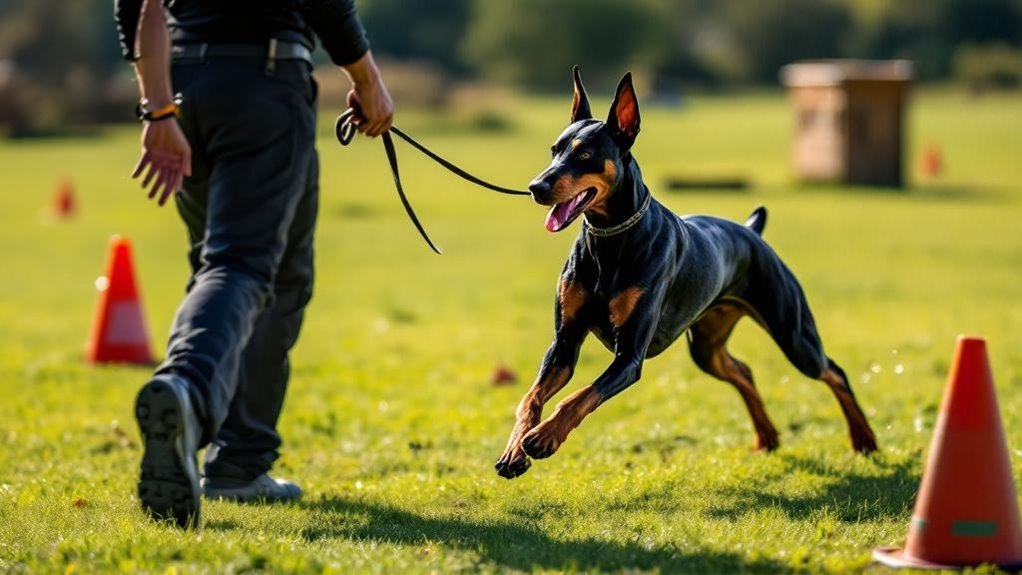
Training your Doberman for IGP requires working with their natural intensity rather than suppressing it, building a methodical three-year progression that honors their slow maturation. Start with foundational obedience and impulse control at six months, introduce tracking by one year, and begin structured protection work at eighteen months. Find a trainer with proven Doberman experience, avoid capping drive early, and condition your dog gradually for trial pressure through mock competitions. Understanding gender-specific traits and properly sequencing each phase determines whether you’ll develop a reliable trial partner.
- Key Takeaways
- Male vs. Female Dobermans: How Gender Shapes Your Training Strategy
- Why Dobermans Mature Slowly: Implications for Your Timeline
- Finding a Trainer Who Actually Understands Dobermans
- Channel Natural Protection Drive Without Over-Excitement
- Build a Solid Foundation in Obedience First
- Master IGP Tracking: The First Phase Explained
- Navigate Obedience Under Pressure and Distraction
- Protection Work in IGP: What Judges Expect
- Don’t Cap Drive Early: The #1 Doberman Training Error
- Condition Your Doberman for Trial Pressure
- Your 3-Year Roadmap: Training Timeline for Doberman Maturity
- Frequently Asked Questions
- Conclusion
Key Takeaways
- Begin foundational obedience at six months, introduce tracking by one year, and structured IGP training by eighteen months for proper development.
- Select trainers with proven Doberman IGP experience, verified by titled dogs in trials and active membership in working dog organizations.
- Teach controlled protection work emphasizing courage, restraint, obedience, and predictability while avoiding early drive suppression for long-term reliability.
- Gradually introduce environmental distractions and mock trials to build resilience under competition pressure while maintaining focus on commands.
- Recognize female Dobermans require experienced handlers for channeling protective instincts and work drive, while males offer steadier temperaments in structured IGP environments.
Male vs. Female Dobermans: How Gender Shapes Your Training Strategy
Gender matters when you’re training a Doberman for IGP, and understanding these differences’ll help you tailor your approach to your dog’s natural tendencies.
Male Dobermans typically exhibit steadier temperaments and more consistent decision-making, making them generally easier to manage for novice trainers preparing a working dog for personal protection trials.
Females often display heightened protective instincts and stronger work drive, requiring experienced handlers who can provide clearer boundaries and consistent guidance.
Female Dobermans display heightened protective instincts and stronger work drive, requiring experienced handlers who provide clear boundaries and consistent guidance.
Female guard dogs may react more quickly in stressful situations, demanding training approaches that reinforce impulse control and self-regulation.
Males tend to show more even demeanor during sessions, offering reliability in IGP’s structured environment.
Females demonstrate greater focus and intensity but need handlers capable of channeling these qualities effectively.
Recognizing these tendencies allows you to develop a strategy aligned with your dog’s inherent characteristics.
Why Dobermans Mature Slowly: Implications for Your Timeline
Unlike many sport-bred dogs that reach functional maturity within 18 to 24 months, Dobermans don’t fully mature—both physically and mentally—until they’re 3 to 4 years old. This means your training timeline needs to reflect this slower developmental pace rather than rush through critical stages.
You’ll build skills gradually, prioritizing foundational obedience and impulse control before advancing to complex work. This structured approach is the gold standard when training Dobermans, and your local club can help you establish realistic milestones.
Pushing too hard early risks capping drives permanently, undermining future performance. Work with trainers experienced in Doberman development, ensuring consistency throughout each phase so your dog develops reliable, mature responses essential for IGP success.
Finding a Trainer Who Actually Understands Dobermans
You’ll want to seek trainers with proven experience specifically with Dobermans, as their temperament and maturation timeline differ fundamentally from other working breeds like Malinois or molossors, requiring specialized knowledge that general trainers may not possess.
Ask potential trainers about their track record with off-breeds, particularly how many titled Dobermans they’ve produced and their success rate in preparing dogs for IGP trials, since this concrete evidence reveals whether they’ve truly mastered the breed’s unique demands.
Look for trainers who understand Doberman behavior deeply enough to read pressure sensitivity and adjust their methods accordingly, ensuring they can build foundational skills gradually without overwhelming your dog during those critical developmental years.
Specialized Knowledge and Experience
Because Dobermans possess a distinct temperament and drive that differ markedly from other working breeds, finding a trainer with specific IGP experience becomes essential to your dog’s development. You’ll want to ask potential trainers directly about their track record with Dobermans, specifically how many they’ve successfully titled in IGP competitions. This proven history demonstrates their understanding of the breed’s unique requirements, not just general working dog knowledge.
| Evaluation Criterion | What to Assess |
|---|---|
| Breed-Specific Results | Number of titled Dobermans trained |
| Club Affiliations | Active membership in working dog organizations |
| Training Philosophy | Understanding of gradual skill development |
| Decy Experience | Knowledge of Doberman behavioral nuances |
| Foundation Focus | Emphasis on proper foundational work |
Trainers embedded in clubs specializing in working dogs typically maintain higher standards and access to resources that benefit your Doberman’s training trajectory.
Track Record With Off-Breeds
Many trainers working in IGP develop their expertise primarily with Malinois and German Shepherds, which means they’ve built their methods around breeds that respond predictably to conventional pressure and drive management.
Dobermans require different handling, so you need to verify a trainer’s specific experience with off-breeds before committing. When evaluating potential trainers, consider these factors:
- Ask how many Doberman titleholders they’ve produced in IGP competitions
- Request references from clients who’ve trained Dobermans with them
- Inquire about their understanding of breed-specific temperament and structure
- Examine their track record across multiple off-breeds, not just Dobermans
A trainer’s success with Malinois doesn’t guarantee competence with your Doberman. Look for documented results, active club involvement, and a clear philosophy about graduated skill building specific to your breed’s needs.
Evaluating Decy Competence Levels
The decoy—or helper—plays a critical role in your Doberman’s training, yet this position demands a specific skill set that extends beyond general IGP experience. You need someone who reads Doberman body language with precision, understanding how your dog’s drives manifest differently than other breeds.
A competent decoy recognizes the subtle shifts in your Doberman’s intensity and adjusts pressure accordingly, preventing misinterpretation of breed-specific behaviors. Ask potential decoys about their experience with Dobermans specifically, not merely their general helper credentials.
Inquire how they structure sessions to build your dog’s confidence gradually, ensuring consistency across training phases. Their reliability in delivering appropriate pressure and recognizing when your Doberman needs tempo adjustments directly determines your trial success.
Channel Natural Protection Drive Without Over-Excitement
While Dobermans possess strong natural protective instincts, you’ll want to channel these drives through structured training rather than allowing them to develop unchecked. You can accomplish this by implementing several key strategies:
- Use positive reinforcement to reward calm, correct behaviors during protection scenarios, which redirects their protective drive into focused tasks.
- Practice impulsive control exercises, such as controlled calmness drills, to reinforce patience and reduce reactive overaggression.
- Gradually introduce helpers in protection training, allowing your dog to assess situations before reacting.
- Incorporate socialization with distractions in controlled settings so your Doberman distinguishes everyday situations from genuine threats.
This approach builds reliability and consistency in your dog’s responses, ensuring their natural protectiveness becomes a controlled asset rather than an unmanageable liability during IGP trials.
Build a Solid Foundation in Obedience First
Once you’ve established control over your Doberman’s protective instincts through structured channeling and calm responses, you’re ready to build the obedience foundation that’ll support all future training.
Start with basic commands—sit, stay, and heel—which create the framework for reliable performance in IGP trials. Consistency matters tremendously; give commands in the same tone and manner every time, reinforcing understanding and reliability.
Use positive reinforcement like treats and praise to motivate your dog and strengthen your bond. Gradually introduce distractions to teach focus and composure under pressure.
Progress deliberately, ensuring your Doberman masters each skill before advancing to complex tasks. This methodical approach builds the solid skill set necessary for IGP success, preventing gaps that could undermine later training phases.
Master IGP Tracking: The First Phase Explained
You’ll start IGP tracking by teaching your Doberman to recognize and indicate specific scent articles, which forms the reliable foundation for all advanced tracking work.
Building these foundational skills requires you to establish consistency in how your dog responds to scents across different surfaces and environmental conditions, gradually introducing variations in track age and length to strengthen their discrimination abilities.
Your role as handler is critical here—you’ll maintain steady pacing and clear communication, reinforcing your dog’s natural scenting instincts while teaching them to work through distractions with focus and precision.
Scent Article Recognition Techniques
Teaching your Doberman to recognize and locate scent articles forms the foundation of IGP tracking success, establishing the reliability and focus that’ll define your dog’s performance throughout all phases of competition.
You’ll develop this skill through systematic progression:
- Introduce articles paired with positive reinforcement, creating strong associations between the item and rewards.
- Practice consistent sessions to build your dog’s confidence and establish reliable down indications at article locations.
- Vary distances and terrain gradually, guaranteeing your Doberman adapts to different environmental conditions.
- Maintain steady progress by reinforcing correct behavior while adjusting difficulty incrementally.
This structured approach guarantees your dog masters scent recognition with precision.
Consistency remains vital throughout training, as each session strengthens neural pathways essential for accurate article detection during trials.
Building Foundational Tracking Skills
While scent article recognition teaches your Doberman to identify and indicate specific objects, foundational tracking skills build the broader ability to follow a continuous human scent trail across varying terrain and conditions.
You’ll gradually increase trail length and complexity, introducing turns and varied surfaces to strengthen your dog’s focus and adaptability. Start with shorter, simpler paths in controlled environments, then progress systematically as your Doberman demonstrates reliability.
Consistent practice across different locations builds confidence and teaches your dog to concentrate on scent despite environmental distractions. Throughout this phase, maintain clear communication through verbal cues and body language, reinforcing correct behaviors with high-value rewards.
Working alongside experienced trainers guarantees you’re establishing solid foundational structure before advancing to trial-level challenges.
Navigate Obedience Under Pressure and Distraction
Mastering obedience commands requires your Doberman to respond reliably in real-world conditions where distractions compete for their attention.
This skill develops through deliberate, structured practice rather than controlled environments alone. You’ll build this reliability by implementing these key strategies:
Reliability in obedience stems from deliberate, structured practice across varied environments, not controlled settings alone.
- Begin in calm settings, then gradually progress to environments with increased distractions.
- Keep training sessions brief, around 5-10 minutes, to maintain focus and prevent overwhelm.
- Incorporate structured drills featuring other dogs, people, and sounds to simulate trial conditions.
- Reward high-value responses with favorite toys or treats, reinforcing consistent performance.
This progressive approach allows your Doberman to develop confidence while learning to execute commands despite environmental pressure.
Your consistency in practicing across varied locations and scenarios directly determines whether your dog maintains obedience when competing demands arise during trials.
Protection Work in IGP: What Judges Expect
Because protection work represents a crucial portion of IGP competition, you’ll need to understand that judges aren’t looking for aggressive displays or uncontrolled reactions—they’re evaluating your dog’s courage balanced against restraint, obedience, and predictability in high-pressure situations.
Your Doberman must bark and locate the helper during search exercises, demonstrating alertness while remaining calm and focused. Controlled biting matters greatly; judges assess whether your dog engages with the helper only when you cue engagement and releases immediately on command, showing genuine impulse control.
Throughout protection exercises, you maintain clear communication through consistent signals, and your dog responds reliably without overreacting to distractions. This cooperative teamwork between handler and dog—built on structure, consistency, and reliability—distinguishes successful performance from failed evaluations.
Don’t Cap Drive Early: The #1 Doberman Training Error
You’ll make a critical mistake if you suppress your Doberman’s drive before they’ve developed the foundational skills to channel it effectively, since premature capping creates behavioral instability rather than control.
Dobermans mature slowly and require gradual skill building across tracking, obedience, and protection work, which means you need to cultivate their natural energy and instinct systematically instead of restricting them early.
Understanding Drive Suppression Risks
One of the most damaging mistakes trainers make with Dobermans is imposing artificial limits on drive during early development, a practice that fundamentally misunderstands how these dogs mature and build competence. When you suppress drive prematurely, you create lasting consequences that extend far beyond initial training phases.
Understanding these risks helps you make better decisions:
- Incomplete foundational skills leave gaps that compound during advanced training
- Early suppression triggers underlying behavioral issues affecting competition responsiveness
- Restricted enthusiasm diminishes the natural energy necessary for trial performance
- Slow maturation requires gradual skill building without artificial constraints
Dobermans develop differently than other breeds, necessitating trainers who recognize pressure dynamics and apply relief strategically.
You must maintain drive throughout training, allowing their potential to unfold naturally rather than imposing limitations that undermine their long-term reliability and engagement.
Gradual Skill Development Timeline
The foundation you build during a Doberman’s early training determines what they’ll reliably perform under pressure later, which means the timeline for skill development can’t be rushed or artificially compressed to fit a predetermined schedule.
You’ll progress through foundational skills, intermediate challenges, and advanced work by consistently evaluating your dog’s readiness at each stage. This measured approach allows their drive to develop naturally rather than become suppressed through overwhelming demands.
You introduce varied training experiences that gradually increase in difficulty, matching intensity to their maturity level and individual temperament.
Positive reinforcement maintains engagement throughout, preventing burnout while building reliability. Each phase supports the next, creating a structure where your Doberman develops both technical competence and the confidence necessary for consistent performance.
Condition Your Doberman for Trial Pressure
Building your Doberman’s resilience under pressure requires a structured approach that gradually increases environmental challenges while maintaining focus on handler commands.
You’ll develop consistency and reliability through deliberate practice that mirrors actual competition conditions.
- Introduce controlled distractions systematically, such as placement of objects or training helpers in view, while your dog performs obedience and protection work.
- Create simulated trial environments by inviting noise and other dogs to reproduce authentic competition pressure.
- Use positive reinforcement to reward calm behavior and control during high-pressure scenarios, ensuring your Doberman prioritizes your commands over external stimuli.
- Conduct routine mock trials and desensitization sessions to normalize the trial experience, reducing anxiety when actual competition arrives.
This progression builds your dog’s confidence and focus systematically, ensuring reliable performance under genuine trial conditions.
Your 3-Year Roadmap: Training Timeline for Doberman Maturity
Since Dobermans mature slowly and require gradual skill development, you’ll need a structured three-year training timeline that builds foundational competencies before advancing to specialized work.
Start socialization and basic obedience at six months to establish a stable temperament.
By one year, introduce tracking exercises to develop scenting skills and build confidence following human scent trails.
At eighteen months, engage in structured obedience training emphasizing precision in heeling, recalls, and retrieves.
At two years, begin specialized protection training focusing on controlled biting, searching, and impulse control.
Frequently Asked Questions
What Is the 7 7 7 Rule for Puppies?
You should expose your puppy to seven different environments, introduce them to seven new people, and provide seven new experiences by seven weeks old. This early socialization builds confidence and reduces behavioral problems.
How Difficult Is It to Train a Doberman?
You’re climbing a mountain rather than a hill—Dobermans demand patience as they mature slowly. You’ll need specialized knowledge to read their unique drives and avoid capping their potential prematurely.
Can I Train My Dog to Do Deep Pressure Therapy?
Yes, you can train your Doberman for deep pressure therapy. You’ll use positive reinforcement, teach leaning behaviors, and gradually desensitize them to distractions. Consistency and prior working dog experience guarantee you’ll succeed effectively.
What Is the 10-10-10 Rule for Puppies?
You’ll dedicate ten minutes to training, ten to play, ten to socialization—balancing focus with fun while building your puppy’s confidence. You’re establishing routines that expand as they mature.
Conclusion
You’ve got your work cut out for you, but success in IGP trials hinges on patience and structure. Your Doberman’s natural drive, combined with consistent obedience foundation and proper conditioning, creates the reliability judges seek. Don’t put the cart before the horse by rushing protection work; instead, build methodically through your three-year timeline. Channel drive without excess, stay committed to consistency, and you’ll develop a capable trial partner.